
Vertical Radiator Guide: Size, Style, & Install for 2026
You’re probably looking at a room where the old radiator dictated everything.
The sofa can only go on one wall. The dining table has to sit too close to the door. The hallway feels pinched. The kitchen has cabinets on every sensible run of wall, and the only spare section is tall and narrow. That’s usually the moment a vertical radiator moves from “nice idea” to “practical answer”.
A good vertical radiator doesn’t just heat a room. It can free up layout options, tidy up awkward spaces, and turn a necessary heating appliance into part of the interior. The key is choosing one in the right order. First the heat requirement. Then the shape and finish. Then the pipework, valves, and fitting details that decide whether the result feels effortless or frustrating.
The Modern Heating Solution for Awkward Spaces
A common UK renovation problem goes like this. You improve the room, add better furniture, maybe open up a wall or fit larger windows, and suddenly the old horizontal radiator is in the way. It still works, but it steals the exact stretch of wall you need.
That’s why so many homeowners start looking upward instead of sideways. A vertical radiator uses height to solve a layout problem. In a galley kitchen, it can fit between cabinets and a doorway. In a lounge with glazing across one side, it can sit on a narrow return wall. In a small cloakroom, it can warm the space without taking over the room.
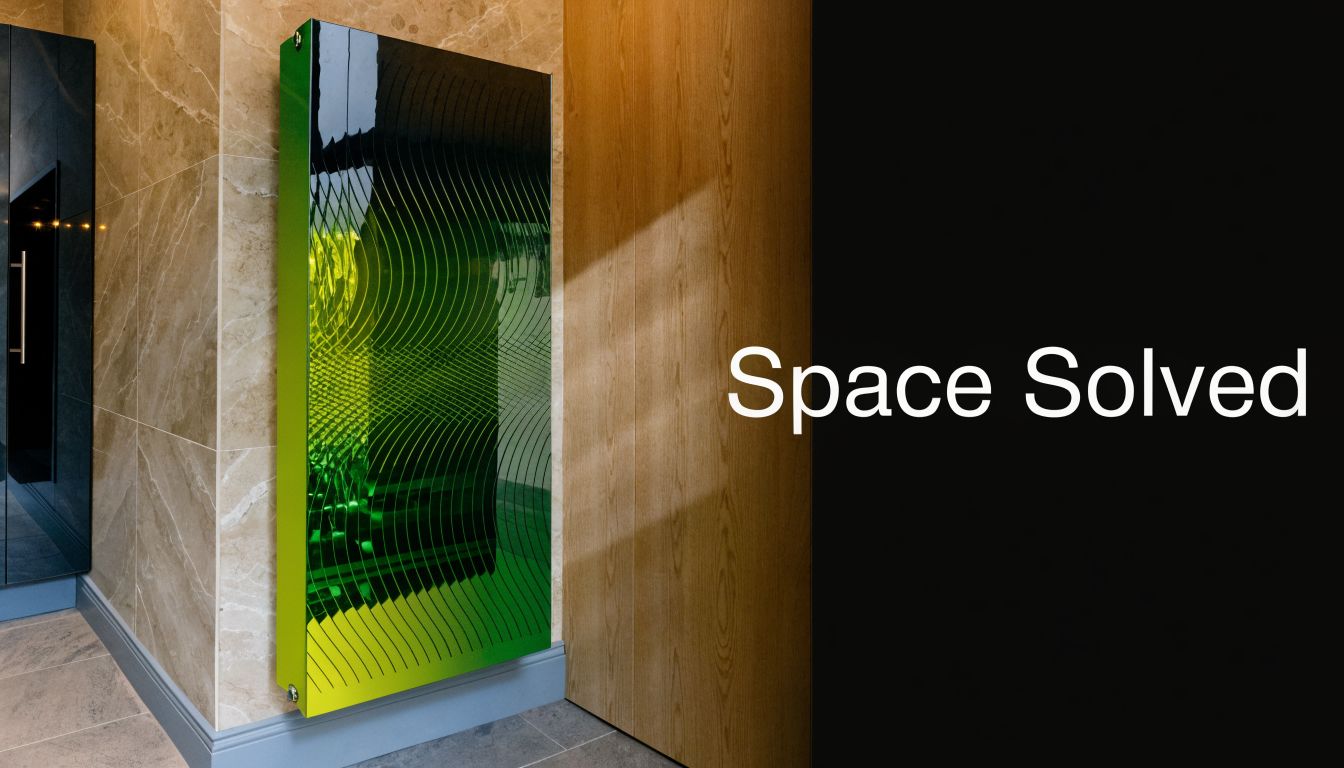
If that sounds like your home, browsing a small cloakroom radiator can help you see how narrow formats work in real rooms.
Practical rule: If your room has enough height but not enough usable width, a vertical radiator is often the cleanest way to recover wall space.
There’s also a design benefit. Vertical models can read more like an intentional feature than a leftover utility item. That matters in spaces where every visible element counts, especially in modern kitchens, compact bedrooms, and hallways where there isn’t much room for visual clutter.
Understanding the Vertical Radiator Concept
A vertical radiator isn't just a normal radiator rotated upright. That’s one of the biggest points of confusion.
Its shape is tall and narrow, but the important difference is how it’s engineered to move hot water and release heat across that taller body. The goal is to make a compact footprint work hard, especially where wall width is limited.
Why the shape works
Think of a vertical radiator as a kind of heat chimney. Warm water moves through the radiator body, the metal surface heats up, and warm air rises alongside it. That upward movement helps circulate warmth from lower level to higher level through the room.
The effect is helped by the way many vertical models are built. The verified UK guidance notes that heat output comes from the BTU rating, not from the radiator being upright on its own, and that vertical models use features such as multi-column construction and internal baffles to spread water evenly through the full height and support that chimney effect. The same source notes outputs typically ranging from 443W to 1567W under UK industry standards for this category of product in certain configurations, and that equal BTU ratings mean equal heat output regardless of orientation, as explained in this UK guide to vertical radiators.
That point matters. People often ask whether vertical radiators are “less powerful” because they’re narrower. The better question is whether the model you’re considering has the right output for the room.
Why they aren’t a passing trend
Vertical heating elements have been around far longer than many people realise. Their development goes back to mid-19th century innovation, and late Victorian cast iron models with vertical forms became part of British interiors as central heating and hygiene standards improved. Later, the 1970s saw steel radiator production and space-saving domestic heating become far more common in UK homes, especially where compact room layouts made a tall format useful. The same historical source notes that over 60% of UK households rely on radiators for primary heating today, which helps explain why the format has stayed relevant rather than disappearing as a design fad, according to this history of cast iron radiators and vertical forms.
What homeowners usually get wrong
Most mistakes happen when people choose with their eyes only.
They see a tall radiator that fits the wall and stop there. But a smart choice balances three things:
- Heat requirement. The radiator must match the room’s heat loss.
- Physical fit. Height, width, and pipe positions must suit the wall and furniture plan.
- Use of the room. A hallway, en-suite, bedroom, and kitchen all have different practical demands.
A vertical radiator is a layout tool as much as a heating appliance. It solves a room-planning problem only if the heat output and placement also make sense.
That’s why the next step isn’t colour or finish. It’s sizing.
How to Size Your Vertical Radiator for Perfect Heat
The most important number in your buying decision isn’t the height, the finish, or whether the radiator has flat panels or columns. It’s the BTU requirement for the room.
BTU stands for British Thermal Unit. In practical terms, it tells you how much heat the room needs. If you undersize the radiator, the room may never feel properly warm. If you oversize it, you can end up paying for more radiator than the space really needed.

Start with the room, not the radiator
Homeowners often do this backwards. They find a radiator they like, then hope it will be enough. A better method is to size the room first and narrow the product list second.
Use a proper calculator rather than guessing. A tool such as this BTU calculator guide for a room is useful because it prompts you to enter the details that affect heat loss.
Those details usually include:
- Room dimensions. A larger room needs more heat than a smaller one.
- Window area. More glazing usually means more heat loss.
- External walls. Rooms exposed on more than one side tend to need more output.
- Insulation level. Older properties and poorly insulated spaces usually need more help.
- What’s above and below. A room over an unheated area often behaves differently from one surrounded by heated rooms.
Why orientation isn’t the deciding factor
Many buyers relax once they understand the basic rule. A vertical radiator is not weaker just because it is vertical.
As noted earlier, the verified guidance states that two radiators with the same BTU rating produce the same amount of heat, regardless of whether one is vertical and the other horizontal, with the vertical model achieving that through design features such as columns and internal baffles that support even heat distribution and natural convection.
That means your sizing process should focus on required output first. Once you know the BTU target, you can compare models that fit your wall.
A simple way to think about sizing
If you’re standing in a bedroom with one narrow free wall, ask three questions:
- How much heat does the room need?
- How much wall height and width do I have?
- Will the radiator sit where air can circulate well and furniture won’t block it?
That’s the practical filter.
A tall, slim model may be ideal in footprint terms, but if the output doesn’t meet the room’s requirement, it’s the wrong choice. On the other hand, a compact vertical model with the correct BTU can work very well in spaces where a horizontal alternative would dominate the wall.
What the product specs tell you
Once you know the heat requirement, the specification sheet starts to make more sense.
Look at:
- BTU or wattage output
- Height and width
- Type or panel construction
- Pipe centre distances
- Projection from wall
The verified UK data for vertical radiators notes standard market dimensions such as heights in the 1600-2400mm range for many models and gives construction details like mild steel bodies, top bleed valve positions, and specifications used for BTU calculation across room types. Those details are useful because they show why a narrow radiator can still offer meaningful output in a compact footprint.
A quick explainer can help if you want to see the basics in action.
Common sizing mistakes
Don’t size for the empty room on the floorplan. Size for the real room, with its windows, insulation level, and external exposure.
The usual errors are predictable:
- Choosing by appearance alone. A slim designer model may look right but still need checking against the room’s heat demand.
- Ignoring renovation changes. New flooring, insulation, glazing, or altered furniture layout can change the best radiator choice.
- Forgetting awkward rooms. Hallways, kitchens, and loft rooms often behave differently from standard square bedrooms.
If you want confidence before buying, write down the room measurements, note glazing and outside walls, and run the calculator. That one step removes most of the guesswork.
Finding a Style and Finish to Match Your Interior
Once the heat requirement is set, you can choose the radiator that suits the room visually. This is the stage often found more enjoyable, because the decision becomes less about uncertainty and more about fit, proportion, and character.
A vertical radiator can blend in quietly or act as a design feature. Which route works better depends on the room and on everything around it, from joinery and wall colour to flooring and furniture scale.
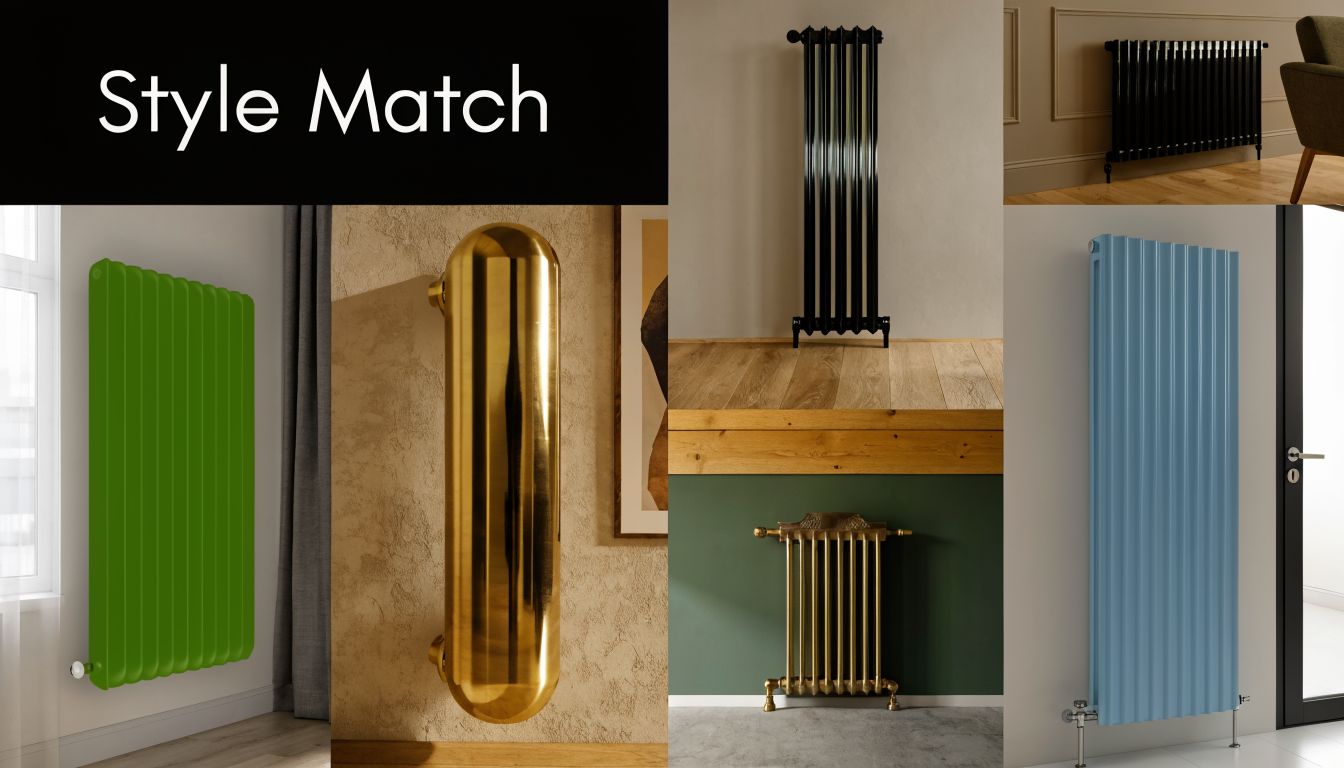
Choosing the overall style
There are a few broad looks that cover most homes.
| Style | Best fit | Visual effect |
|---|---|---|
| Flat panel | Modern kitchens, extensions, minimalist rooms | Clean, architectural, understated |
| Column | Period homes, transitional interiors, lounges | Softer lines, more traditional character |
| Designer shapes | Feature walls, statement spaces, contemporary schemes | Decorative, sculptural, noticeable |
Column models are especially popular when you want a vertical radiator that still feels connected to traditional British heating style. The verified data notes that modern vertical designer options can include models with up to 6 columns and finishes such as anthracite or white, alongside warranties in the 5-10 year range in that market context, as described in the earlier historical source.
Finish changes the mood of the room
The same radiator shape can feel completely different in another finish.
The verified UK market information for modern vertical radiators highlights white, anthracite, and black nickel as common finishes, with mild steel construction and tall, narrow dimensions suited to alcoves and tight spaces, as described in this living room designer radiator collection and supported by the product-format details in the underlying market description.
Here’s how those finishes tend to work in real rooms:
- White works well when you want the radiator to recede into a pale wall and keep the room feeling light.
- Anthracite gives a sharper, more contemporary edge and often pairs well with dark-framed glazing, black accessories, and timber.
- Black nickel brings more presence and can suit dramatic interiors or spaces with metal accents.
Material and practical feel
Most UK vertical radiators in this category are mild steel, and the verified data notes a maximum operating pressure of 10 bar for typical models in that market segment. That matters less for aesthetics and more for compatibility and product specification.
From a homeowner’s point of view, material choice affects things like weight, feel, and how the radiator sits within the broader design. A taller model in steel often feels solid and architectural. If you’re fitting into a narrow alcove or on a wall that needs careful planning, the installer will also care about fixing points and support.
Matching style to room use
A good visual choice also respects how the room functions.
- In a kitchen, a flatter vertical shape often looks neater beside tall units.
- In a bedroom, a column design can soften the room and work well with painted joinery.
- In a hallway or landing, a bold finish can make the radiator feel intentional rather than squeezed in.
The right finish doesn’t just match the room. It decides whether the radiator disappears politely or helps define the whole space.
If you’re torn between two looks, go back to the wall itself. On a busy wall with art, switches, and furniture, simpler is usually stronger. On a plain narrow wall, a more expressive vertical radiator can carry the space well.
Planning Your Installation and Choosing Valves
A radiator can be correctly sized and still disappoint if it’s installed in the wrong place or with the wrong valve arrangement. Such scenarios underscore the value of careful planning.
The old rule for horizontal radiators was simple. Put them under the window where possible. That helped create a warm air curtain against a colder part of the room. A vertical radiator often goes elsewhere because the whole point is to use a tall, narrow wall that a horizontal model couldn’t use.
Placement matters more than many people expect
That shift in position changes the room’s airflow pattern. Verified guidance on the subject notes that vertical radiators are often installed on internal walls rather than beneath windows, and that this can affect convection patterns and potentially influence condensation on colder surfaces such as windows, especially in retrofit situations where wall options are limited, as discussed in this review of vertical radiator pros and cons.
What should you do with that information? Treat placement as a room-by-room decision.
For example:
- If the room already has condensation issues, don’t ignore the colder window wall just because the vertical radiator looks better on the opposite side.
- If the wall under the window is unavailable, consider whether better ventilation, improved insulation, or a revised heat-loss calculation is sensible.
- If furniture will sit close by, leave enough room for air movement rather than boxing the radiator in.
Choosing the right valve type
Valves confuse a lot of buyers because there are two decisions hiding inside one purchase. You need to choose the control type and the pipework format.
A good primer such as this radiator valves explained guide is useful because it helps translate product listings into practical decisions.
The main control choices are:
- Manual valves. Simple, straightforward, and often chosen for appearance.
- Thermostatic valves. Better when you want room-by-room temperature control.
- Designer valves. Often selected to match the finish and style of a visible radiator.
Then there’s the pipe entry:
| Pipework situation | Valve style often used |
|---|---|
| Pipes rising from floor | Straight or angled, depending on exact alignment |
| Pipes coming from wall | Angled or corner |
| Tight decorative install | Chosen to suit both spacing and appearance |
When to bring in a professional
If the pipe centres need moving, the wall construction is uncertain, or the radiator is heavy and tall, professional fitting is usually the safer route. The work isn’t only about hanging the radiator level. It also includes secure fixing, valve selection, bleeding, pressure checks, and making sure the final position works both technically and visually.
A vertical radiator has to be right in two ways. It must perform as heating, and it must sit well enough in the room that it doesn’t feel like an afterthought.
That’s why installation planning should happen before you order, not after the boxes arrive.
Vertical vs Horizontal A Clear Comparison
Sometimes the choice is obvious. If you’ve only got a narrow strip of free wall, the vertical option usually wins. In other rooms, both formats could work, so it helps to compare them directly.
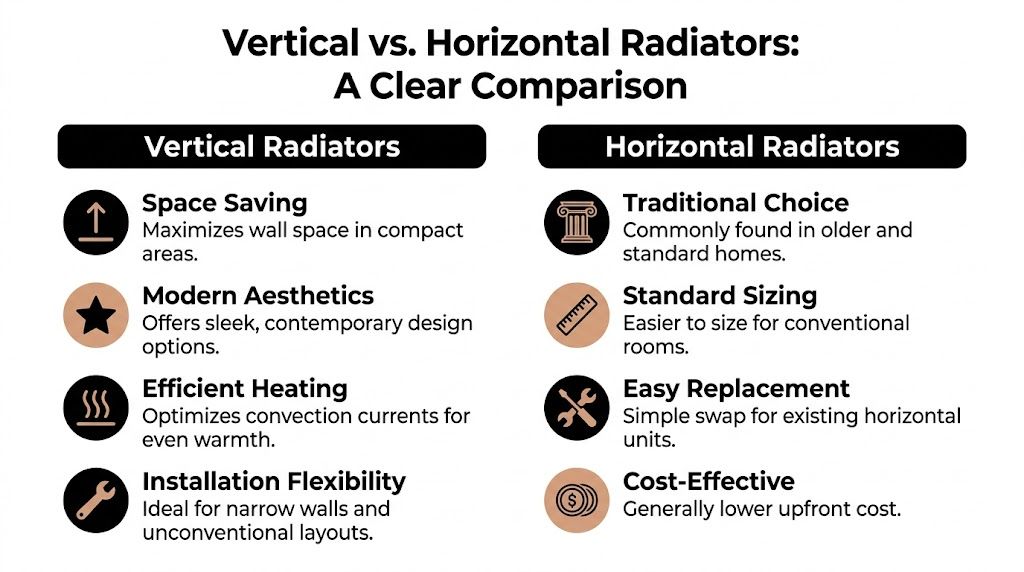
Vertical vs Horizontal Radiators Which is Right for You
| Factor | Vertical Radiator | Horizontal Radiator |
|---|---|---|
| Space efficiency | Uses wall height well in narrow areas | Uses width well on longer open walls |
| Furniture planning | Frees up lower wall space | Can limit sofa, cabinet, or table placement |
| Appearance | Strong visual feature, often more contemporary | Familiar, quieter, often easier to blend in |
| Placement flexibility | Useful for alcoves, returns, and awkward gaps | Suits conventional wall layouts |
| Replacement ease | May need more planning if changing pipework | Often easier when replacing like for like |
| Traditional under-window use | Less common | More natural fit for classic placement |
| Best suited to | Compact rooms and design-led layouts | Standard rooms with wide free wall sections |
When vertical makes more sense
A vertical radiator is usually the stronger choice when the room suffers from a wall-space problem rather than a heat problem. You still size it correctly, but the key advantage is that it lets the room function better.
That often applies to:
- Kitchens with tall units and little spare wall
- Hallways and landings with narrow returns
- Bedrooms where you want space for wardrobes or a desk
- Living rooms dominated by glazing or media units
If you’re comparing options generally, this broader guide on how to choose a radiator can help frame the decision around room shape and use.
When horizontal still wins
A horizontal radiator still has some clear advantages. It often suits straightforward replacements, especially if existing pipework is already in place. It also remains a practical answer beneath windows where the layout allows it.
For many homes, the decision isn’t about one type being universally better. It’s about which type solves the room’s actual constraint with the least compromise.
If your room has generous uninterrupted wall width, horizontal may stay the simpler answer. If the room is fighting you for layout, vertical often gives that space back.
Your Next Steps to a Warmer Stylish Home
A vertical radiator works best when you choose it in the right order. First, calculate the heat requirement. Then pick a size that physically fits the wall. After that, choose the style, finish, valves, and installation plan that suit the room.
That process is simpler than it first appears. The technical part comes down to proper BTU sizing and sensible placement. The visual part comes down to whether you want the radiator to blend in or stand out. The practical part is making sure pipework, wall fixing, and valve choice all line up.
If you’re ready to move forward, start by measuring the room carefully and checking the available wall space. Then compare radiator outputs against that room’s heat needs. Once those two pieces match, the buying decision becomes far clearer.
A vertical radiator can solve a stubborn layout problem and improve how the room looks at the same time. Done properly, it won’t feel like a compromise. It’ll feel like the version of the room that should have existed all along.
Frequently Asked Questions
Are vertical radiators good for small rooms
Yes, often very good. Their main advantage is that they use height instead of width, which helps in compact rooms where every bit of wall space matters. Cloakrooms, en-suites, small kitchens, box bedrooms, and hallways are common examples.
The important point is still output. Small room doesn’t automatically mean tiny radiator. The room needs enough heat for its layout, insulation, and exposure.
Do vertical radiators heat a room as well as horizontal ones
They can, provided the BTU rating is right for the room. Orientation on its own doesn’t decide performance. The output specification does.
That’s why two radiators with the same required heat output can both work, even if one is vertical and the other horizontal.
Where should a vertical radiator go
The best position is the one that balances wall availability, airflow, and practical use of the room.
In many homes, that means a narrow section of internal wall. But if the room is prone to condensation near windows, or if the traditional under-window wall is particularly cold, placement needs a bit more thought. Good installation planning matters more than copying a trend image.
Are vertical radiators harder to install
Sometimes they need more planning, especially when replacing an existing horizontal radiator. Pipe positions may not match, and the wall fixing needs to suit a tall radiator body.
They aren’t automatically difficult to fit, but accuracy matters. Tall radiators are very visible, so even small alignment errors stand out.
Which valves do I need
That depends on two things. First, whether you want manual or thermostatic control. Second, where the pipes come from.
If the pipes rise from the floor, you’ll usually look at straight or angled options depending on spacing. If they come from the wall, angled or corner valves are often more suitable.
Do vertical radiators work in older UK homes
Yes. They can suit period and older homes particularly well because they help solve awkward room shapes, chimney breast returns, and tighter layouts. A column-style vertical radiator can also sit comfortably with more traditional interiors.
What matters most is matching the room’s heat loss and checking the wall and pipework conditions before installation.
Are they only for modern interiors
No. Flat-panel designs often suit modern spaces, but column vertical radiators can look at home in Victorian terraces, converted properties, and more classic schemes. Finish choice makes a big difference here.
White tends to feel more traditional and quieter. Darker finishes often feel more contemporary or more decorative.
What should I check before ordering
Keep it simple. Confirm these points first:
- Measurements. Height, width, projection, and pipe locations.
- Heat requirement. Work out the room’s BTU need properly.
- Wall condition. Make sure the chosen wall is suitable for secure fixing.
- Valve choice. Match control type and pipe direction.
- Room layout. Check doors, curtains, furniture, and circulation space.
If those are right, the rest of the decision gets much easier.
Do vertical radiators come with warranties
Many do. Warranty length varies by manufacturer and model, so it’s worth checking the product listing rather than assuming all radiators carry the same cover. In the verified data for the UK vertical radiator market, warranty ranges of 5-10 years are noted for certain models and suppliers within that product category.
Is supply and fitting worth combining
For many homeowners, yes. It reduces the risk of buying a radiator, valves, and fittings that don’t line up with the planned installation. It also means the technical and visual decisions can be coordinated from the start.
One example is Bradleys Radiators, which supplies designer radiators, offers a BTU calculator, and provides a fixed-cost installation service through its in-house team. If you want a smoother project from product choice through to fitting, that kind of end-to-end route can be easier to manage than splitting the job across separate suppliers and trades.