
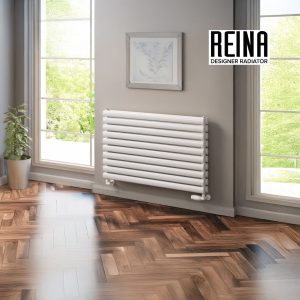
Radiators for 1,400mm pipe centres
Looking for a radiator to fit 1,400mm pipe centres? Nothing we stock lands on 1,400mm exactly, but there are 14 near fits that are a little narrower than your pipes and fit with a pair of rigid tail extensions — we tell you which length.
The pipe-centre figure shown on every radiator below already includes the valves (manufacturers quote the connection centres; add 90mm for a standard pair of angled or corner valves). Wall-to-pipe depth and heat output are shown so you can check the second measurement and the warmth at the same time.
Fits with rigid tail extensions (radiator a little narrower than your pipes)
A pair of rigid extension pieces between valve and radiator closes a gap of up to 50mm a side. Rigid, not telescopic: telescopic tails seal on an O-ring and tend to weep. Split the gap evenly so the radiator sits centred.




Want one that is wider than your pipes?
A radiator wider than the pipe spacing cannot be made to fit with adaptors — the pipework has to be altered. It is a small job on a suspended floor and a bigger one on concrete or tiles.
We can fit it for you. Bradleys is a heating engineer first: across Lancashire we move the pipework and hang the radiator ourselves. Ask for a supply-and-fit quote
Outside our fitting area? Take our one-page brief to your plumber — it lists the measurements, the parts and exactly what to ask for. Open the plumber brief
Enter your postcode to see whether we can fit it for you.
How to measure in two minutes
- Pipe centres. Measure from the centre of one pipe to the centre of the other where they leave the floor or wall. If you measured the gap between the pipes instead, add 15mm (one pipe width).
- Wall to pipe centre. From the finished wall to the middle of the pipe. Singles usually sit 35–50mm off the wall, doubles and columns 60–95mm, towel rails 60–85mm. Different from the old one means packing the brackets or altering pipework.
- Where the pipes come from. Floor pipes with side connections take angled valves; wall pipes take corner valves; underneath connections take straight valves. The pipe centres do not change, the valves do.
- Space and heat. Note the wall space and any height limit under a window, and the output of the radiator you are replacing so the new one heats the room as well.
Want the detail? Read how to measure pipe centres, with the millimetre figures and how much difference you can get away with.
Questions people ask before they buy
What does 1,400mm pipe centres mean?
Pipe centres are the distance between the centres of the two pipes that feed a radiator, measured where they leave the floor or wall. Manufacturers quote the radiator's own connection centres; with a standard pair of angled or corner valves fitted the pipes sit about 90mm further apart (45mm a side), which is the figure we show.
Do the pipe centres have to match exactly?
Within about 10mm, yes — a valve has a little play. If the radiator is narrower than the pipes by up to 50mm a side, a pair of rigid tail extensions closes the gap and we list those as near fits. A radiator wider than the pipes cannot be adapted; the pipework has to move.
Can I use a radiator that is narrower than my pipes?
Yes. Buy rigid extension pieces (15, 20, 30, 40 or 50mm) and fit one each side between the valve and the radiator tail, splitting the gap evenly. Avoid telescopic tails: they seal on an O-ring and are a common source of drips.
What is wall-to-pipe-centre and why does it matter?
It is the distance from the wall to the middle of the pipe at the valve. A single panel sits closer to the wall than a double or a column, so a swap can leave the new radiator's connections 20–40mm further out than the pipes. Up to about 10mm the valves cope; 10–30mm can be packed at the brackets; more than that means offsets or moving the pipes.
Which valves do I need?
Pipes from the floor with side connections: angled valves. Pipes from the wall: corner valves. Connections underneath the radiator or towel rail: straight valves. The thermostatic head goes on the flow side.
Can I put a vertical radiator on 1,400mm pipe centres?
Not without altering the pipework. Vertical radiators have connections 236–660mm apart, so floor pipes 1,400mm apart need to be brought in — usually by cutting them above the floor and running new tails behind the radiator, or by lifting a board. In Lancashire we do this as part of a supply-and-fit; elsewhere, take our plumber brief to a local heating engineer.
Is my old radiator imperial?
If the width is an odd figure such as 1,143mm (45in), 1,270mm (50in) or 1,346mm (53in), it is. Measure the pipe centres as they are, enter them above, and the near-fit results tell you which metric size drops in and the extension length that makes up the difference.