August 2026
Really happy with their products
They look modern and feel good quality. The price was competitive and delivery was prompt. Very pleased and will buy again.
AhmedPrompt delivery, competitive priceRead on Trustpilot

You're probably here because one of two things has happened. Either you've seen a double panel double convector radiator online and thought, “That sounds powerful, but what does it mean?”, or you're replacing an older radiator and don't want to guess your way into the wrong size.
That's a sensible place to pause. Radiator names can sound far more technical than they need to be, and the wrong choice can leave a room slow to warm up, awkward to fit, or bigger than necessary.
A good radiator choice comes down to three things. How it's built, how much heat it gives out, and how well it suits your home. Once those are clear, the decision gets much easier.
The name sounds complicated, but it's really just a description of the radiator's build.
A panel is the flat metal face of the radiator. That surface gives off direct warmth into the room. A convector is the finned metal section tucked inside the radiator. Its job is to warm the air passing through, so that heated air rises and circulates around the room.
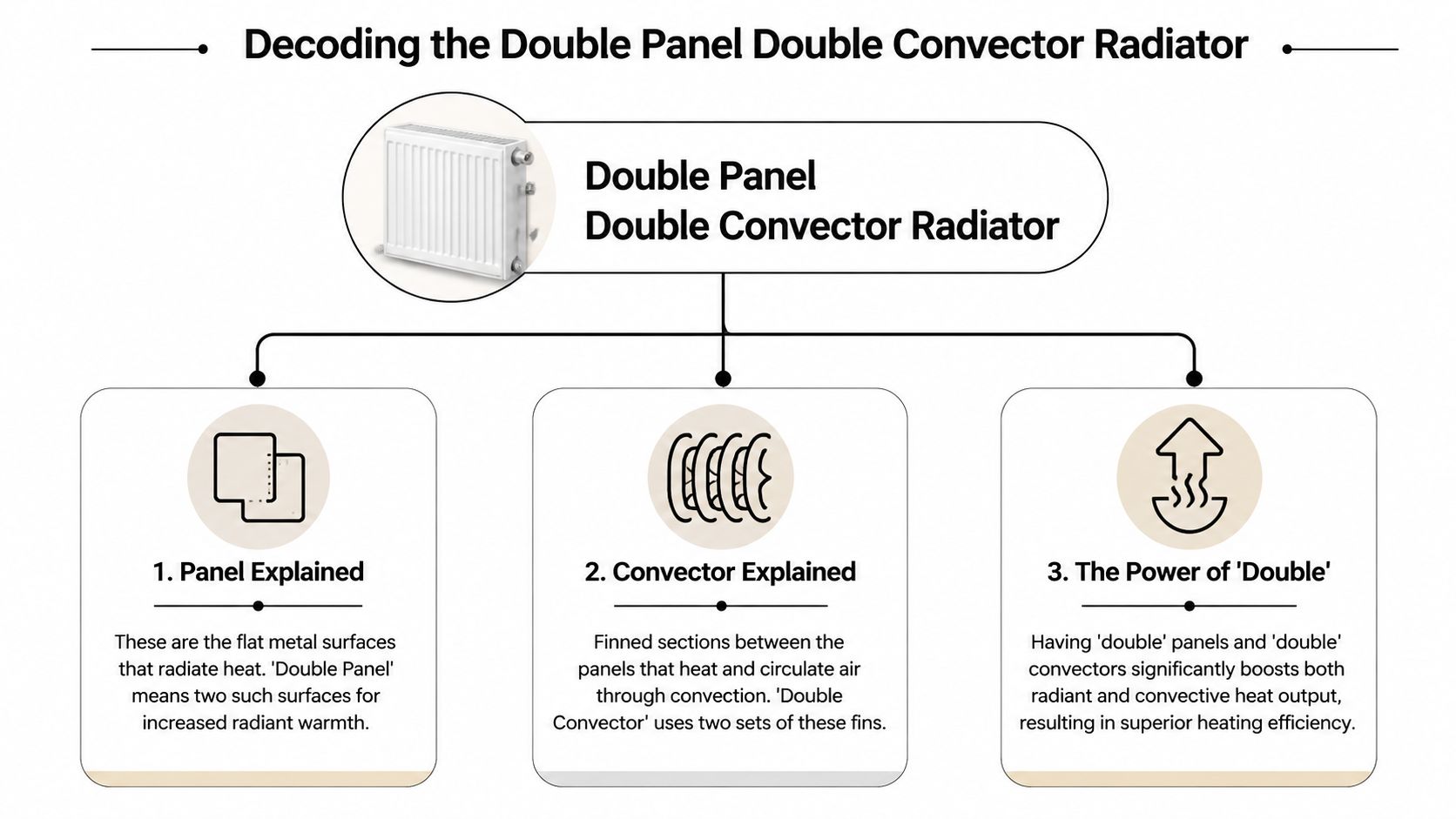
If you imagine a basic radiator as one heated metal surface, a double panel version adds a second heated surface behind the first. That gives the radiator more metal area to release warmth from.
You don't need a larger radiator on the wall to get that extra heating area. That's one of the main reasons people choose this style in UK homes where wall space is limited.
Inside the radiator, the convector fins increase the area that interacts with moving air. A double convector model has two sets of fins rather than one.
Those fins matter because not all heat is felt directly from the metal front. A large part of a radiator's work is warming room air, then sending that air upward so cooler air can move in beneath it. More fins means more opportunity for that air movement to happen efficiently.
Practical rule: If a room struggles to warm up quickly, the internal fin structure matters just as much as the visible front panel.
In UK heating terms, a double panel double convector radiator is usually called a Type 22 radiator. The first “2” refers to two panels. The second “2” refers to two convector fin sets.
That naming system is useful because it gives installers and homeowners a quick shorthand. Instead of reading a full product description every time, you can tell a lot from the type number alone.
The Type 22 radiator configuration emerged in the UK in the 1950s and became the standard for new builds by the 1970s. Its adoption helped reduce domestic fuel consumption by an estimated 25% between 1960 and 1980 by delivering higher heat outputs more efficiently.
That history explains why so many British homes still rely on this format. It solved a practical problem. Homeowners needed stronger heat output without sacrificing more wall space, and the Type 22 design answered that neatly.
A double panel double convector radiator feels more powerful because it uses two kinds of heat transfer at the same time. It gives off radiant warmth from the panels, and it heats moving air through the fins inside.
That combination is why it's such a common choice for living rooms, dining rooms, and older spaces that lose heat faster than a modern boxed room.
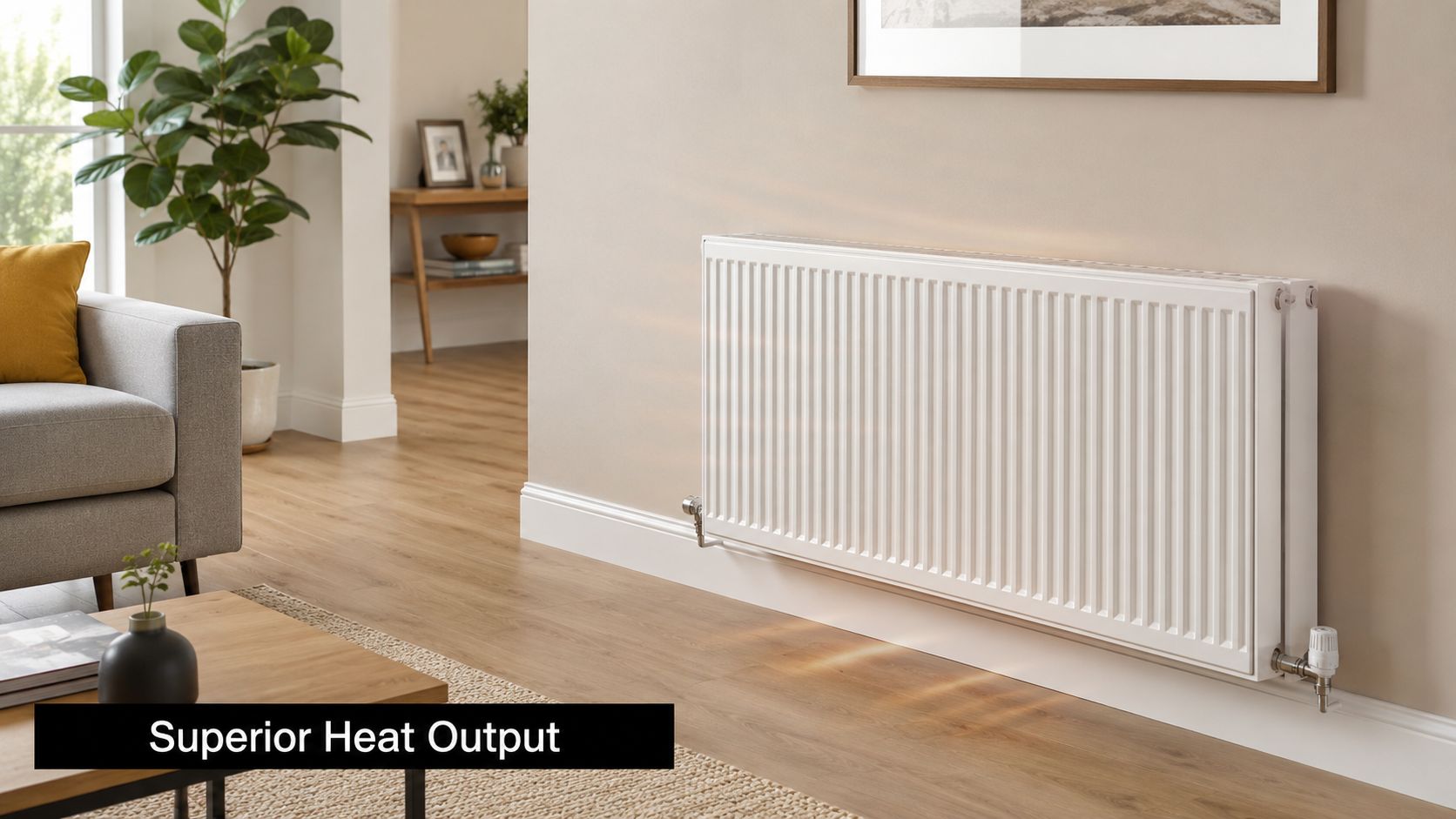
Radiant heat is the warmth you feel when you stand near the radiator. The metal surface warms objects and people in front of it.
Convected heat works differently. Cool air enters near the bottom, passes across the hot fins, then rises as it warms. That creates the circulation that spreads heat across the room instead of keeping it concentrated near one wall.
A Type 22 design strengthens both parts of that process. The extra panel adds radiant surface. The second convector set adds more fin area for air movement.
A Type 22 radiator provides approximately 50% more heat output than a comparable Type 11 radiator of the same size. For example, a 1.5 square metre Type 22 can produce around 2,100 BTUs, while a same-sized Type 11 produces only 1,400 BTUs.
That's the practical difference behind the technical name. Two radiators may look similar from the front, but their internal construction can make one far more capable than the other.
The easiest mistake is judging output by width and height alone. Internal build changes the result.
When you compare radiators, you'll often see heat output shown in BTU/h or watts, sometimes with a note about Delta T50. That published figure is what helps you match radiator output to room heat loss.
A UK-spec Type 22 is commonly listed this way. For instance, a 300 mm x 1600 mm unit is rated at 5,750 BTU/h (1,683 W), with a 10-bar maximum working pressure and 5.6 litres of water content, as shown in this Type 22 product specification.
A different example shows a 600 mm x 1000 mm Type 22 radiator at 6,260 BTU/h, with some Type 22 models specified for operating temperatures up to 120°C and pressures up to 10 bar, as listed on this UK Type 22 radiator page.
Those figures help when you're comparing one size against another, but the important part is this. Room sizing should be based on published output, not guesswork. If you want a quick way to estimate the heat requirement before you compare models, use a radiator heat output calculator.
Here's a practical visual overview of how radiator output works in real rooms.
A radiator can be well made and still be wrong for the room. Sizing is where many people come unstuck.
Too small, and the room never quite feels comfortable in cold weather. Too large, and you may spend more than you need to for a radiator that isn't properly matched to the space.
BTU stands for British Thermal Unit. In radiator buying terms, it's the figure that tells you how much heat output a room needs and how much a radiator can provide.
You don't need to become a heating engineer to use BTUs properly. You only need to treat the number as a target. If your room needs a certain heat output, your radiator or combination of radiators should meet that requirement.
A 2025 UK study found that 42% of homeowners overestimate radiator needs by 15 to 20% when using generic BTU tables, especially in modern homes with high insulation, including homes with U-values below 0.18 W/m²K, leading to inefficient systems.
That matters because many online charts are far too blunt. They often ignore the difference between a draughty Victorian front room and a tightly insulated new-build bedroom. They may also miss orientation, window quality, and how exposed the room is within the house.
If your home is newer and better insulated, an old-style rule of thumb can point you toward the wrong radiator.
A proper sizing method looks at the room as a whole. The most useful checks include:
One straightforward way to work this out is to use a guide that explains how to calculate BTU for a room, then compare the result with the radiator's published output.
In a well-insulated home, a common mistake is assuming “bigger must be safer”. Sometimes it isn't. A well-sealed room may not need the same kind of oversized radiator that an older property would.
On the other hand, compact modern rooms can still need careful planning. Large glazing areas, shaded orientation, and open-plan layouts can all change the final requirement. That's why a room-by-room approach works better than lifting a single rule across the whole house.
There are a few situations where a calculator result is useful but shouldn't be the final word:
In those cases, treat the calculator as your starting point, then sense-check the result against the room's real conditions.
A Type 22 radiator is often the right answer, but not always. The best model depends on the room, the available wall space, and how much output you need from that footprint.
The simplest comparison is between Type 11, Type 21, and Type 22 radiators. Their names tell you how they're built.
| Radiator Type | Structure | Heat Output | Ideal For |
|---|---|---|---|
| Type 11 | Single panel, single convector | Lower than Type 22 in the same size | Small bedrooms, hallways, lighter heat demand |
| Type 21 | Double panel, single convector | Higher than Type 11, lower than Type 22 | Rooms needing a balance of slimmer depth and stronger output |
| Type 22 | Double panel, double convector | Higher output for the same wall footprint | Larger rooms, colder rooms, spaces needing stronger heat delivery |
A Type 11 suits spaces where heat demand is modest and radiator depth matters. You might choose it in a small bedroom, landing, or study where a slim profile is more important than maximum output.
A Type 21 sits in the middle. It can be useful when you want more output than a single panel radiator but don't need the full capacity of a double convector model.
A Type 22 makes the most sense when the room asks more from the radiator. Living rooms with bigger windows, open-plan areas, and rooms in older homes often fit that description.
Choose by heat requirement first, then by shape and style. It's easier to adjust the look than to fix an underpowered room in January.
The trade-off is usually radiator depth. A more powerful internal structure often means the radiator projects further from the wall than a simpler model.
That's not automatically a problem. In many rooms, gaining stronger heat output without increasing width is a very sensible swap. But in a narrow hallway or tight utility room, the slimmer option may be more practical.
Sometimes a Type 22 isn't the best visual fit even if the output is right. In that case, homeowners often look at vertical radiators, multi-column radiators, or larger format designer models.
If your room needs more output from a given area, it can also be worth comparing a Type 33 radiator, which uses an even denser construction than a Type 22. That's usually a decision for spaces with a heavier heat load or limited wall width.
Buying the radiator is only half the job. Fitting it properly matters just as much, especially with a double panel double convector radiator because it's a more substantial unit than a slim single panel model.
The wall, the pipe positions, the valve choice, and the property age all affect how smooth the installation will be.
Before a radiator goes on the wall, the installer needs to know what the wall is made of and whether the supplied brackets are suitable. A solid masonry wall is one thing. Old plaster, uneven brickwork, or repaired internal partitions are another.
Double panel radiators can hold more water and carry more weight than lighter models, so the wall fixing needs to match that reality. If you're replacing like-for-like in a modern room, that's usually straightforward. In older homes, it can be much less predictable.
In pre-1950 UK heritage properties, 38% of radiator installation projects exceed initial cost estimates by 25 to 30% due to unforeseen structural challenges. Specialist mounting solutions are often required, and generic buying guides rarely prepare homeowners for that.
That tends to show up in thick stone walls, uneven surfaces, awkward pipe routes, or the need to work carefully around original finishes. A radiator may look slim enough on paper, but the surrounding structure can still complicate bracket placement, drilling, and final positioning.
Older walls don't always behave like modern walls. The fitting method has to suit the building, not just the radiator.
The right accessories improve control as much as comfort. The main one to think about is the thermostatic radiator valve, usually shortened to TRV.
A TRV helps control room temperature individually, so one room doesn't keep heating just because another part of the house is colder. If you want a practical overview of setup and fitting considerations, this guide on how to install thermostatic radiator valves is a useful reference.
Other accessories worth checking include:
Radiator care doesn't need to be complicated. A few habits make a noticeable difference:
For heritage homes especially, professional fitting is often less about convenience and more about avoiding preventable damage and repeat labour.
Once you know the room's heat requirement, shopping becomes much easier. You're no longer choosing by looks alone. You're filtering by output, size, and practical fit.
That's the point where a specialist retailer can save time, because the search process is clearer when the site lets you narrow options properly.
A common starting point is colour or style. It's understandable, but the smarter order is:
That approach stops you falling for a radiator that looks perfect but doesn't suit the room.
A guide on how to choose a radiator can help if you're still deciding between compact convectors, vertical designs, and more decorative options.

A useful radiator listing should make a few things easy to find:
Bradleys Radiators offers product filters by room, finish, size, and budget, along with a BTU calculator and a fixed-cost installation service from its in-house engineers. That kind of setup is useful when you want one place to handle selection and fitting rather than splitting the process between multiple suppliers and trades.
The biggest friction in radiator buying usually comes from handovers. One place helps you size the radiator, another sells it, and someone else turns up later to fit it and discovers the wall or pipework needs a different approach.
A more joined-up route cuts down that mismatch. It also helps if you're balancing heat output with visual choices, such as deciding between a compact Type 22 for performance or a more decorative radiator for a feature wall.
If you're close to ordering, run through this quick check:
Answer those clearly and your shortlist usually narrows fast.
If you'd like help choosing the right radiator, sizing it properly, and arranging fitting in one place, Bradleys Radiators offers a straightforward route from product selection to installation for UK homeowners upgrading a single room or a whole property.