
BTU Chart for Radiators: The 2026 UK Sizing Guide
You're probably doing what most homeowners do at this point. You've found a radiator you like, the size looks about right, the finish suits the room, then the product page throws BTU, Watts, and Delta T at you and the whole thing becomes less certain.
That confusion is justified. A lot of online advice still mixes old test standards with current UK buying decisions, so people end up choosing radiators that look right on paper but don't heat the room properly in practice. The problem usually isn't the radiator itself. It's the chart behind the choice.
A good BTU chart for radiators should help you narrow options quickly, but it only works if you understand what the figures mean, what assumptions sit behind them, and when the baseline needs adjusting. That's where most guides fall short. This one keeps it practical and centred on what matters in a UK home.
Your Essential Guide to Radiator Sizing
Choosing a new radiator often starts with style and wall space. Then the technical side arrives. You see a tall anthracite vertical model, a compact horizontal panel, maybe a multi-column option, and every one of them carries a different BTU figure. If you don't work with heating every day, it's not obvious which number matters and which ones need a closer look.
BTU is the language of radiator heat output. It tells you how much heat a radiator can deliver. The catch is that not every BTU figure is directly comparable, especially when retailers or old charts use different Delta T standards. That's why two radiators that seem similar can perform very differently in the same room.
The first job is to get a sensible heat requirement for the room. The second is to match that number to a radiator output that reflects modern UK standards. If you want a broader overview of styles, placement and buying factors before getting too deep into calculations, this guide on how to choose a radiator is a useful companion.
Practical rule: Don't buy a radiator because its dimensions resemble the old one. Old radiators were often sized under different assumptions, and replacement by appearance alone is one of the quickest ways to end up short on heat.
A well-sized radiator should warm the room without strain. An undersized one tends to run hard and still leave cold spots. An oversized one can work fine if chosen sensibly, but there's no point paying for output you don't need. The aim is balance, not guesswork.
What Is a BTU and Why It Matters for Your Home
A British Thermal Unit, usually shortened to BTU, is a measure of heat output. In plain terms, it tells you how much heating power a radiator can give to a room. The higher the BTU rating, the more heat that radiator can provide.
That matters because radiator sizing isn't really about the metal box on the wall. It's about whether the room gets warm in a reasonable time and stays comfortable when the weather turns colder. If the output is too low, the room often never feels settled. If the output is much too high for the space, the system can feel clumsy and the radiator may dominate the room for no practical benefit.
What happens when you get it wrong
The most common mistake is undersizing. A room with not enough output usually shows the same signs:
- Slow warm-up times when you switch the heating on
- Cold edges or cold corners near windows and outside walls
- A radiator that feels constantly busy but never quite catches up
- A room that's technically heated but never properly comfortable
Oversizing has a different set of problems. It can eat up valuable wall space, limit furniture layout, and push people into choosing a style that doesn't suit the room. In decorative spaces, that matters just as much as the number on the spec sheet.
Why room context matters
A radiator in a compact, enclosed room behaves differently from one under a window in a draughty space or along a large open wall. Placement, glazing, exposure and room use all affect what that BTU figure needs to achieve. That's one reason an under-window radiator is still a common and practical choice in many homes. It helps counter cold air dropping from glazing and supports more even heat spread across the room.
BTU isn't a sales number. It's the number that decides whether a room feels warm in January or disappointing every evening.
If you treat BTU as the performance side of the purchase, the rest of the decision becomes much easier. You can then choose shape, finish and style without losing sight of the one thing the radiator must do first, which is heat the room properly.
The Quick Reference BTU Chart for Radiators
You measure a room, check an online BTU chart, buy a radiator that looks right on paper, then find the room still feels underpowered in cold weather. In many UK homes, that happens because the chart was based on an older Delta T rating rather than the UK-standard Delta T50 used for modern radiator selection.
This chart is for quick sizing only, but it starts from the right place. Use it to narrow down the output you need before you compare actual radiators. Then check the product output at Delta T50, not Delta T60 or Delta T70, or you risk choosing a radiator that looks powerful in the listing but delivers less heat in normal UK system conditions.
For this table, room height is assumed to be a typical domestic ceiling height. If the ceiling is much higher, or the room has large areas of glazing, exposed walls or awkward heat loss, treat the figures as a baseline.
Estimated BTU Requirements by Room Size and Type
| Room Size (metres) / (sq ft) | Lounge / Living Room (BTU) | Bedroom (BTU) | Kitchen / Hallway (BTU) |
|---|---|---|---|
| 3m x 3m / 97 sq ft | 3815 | 3052 | 2289 |
| 4m x 3m / 129 sq ft | 5087 | 4070 | 3052 |
| 4m x 4m / 172 sq ft | 6783 | 5426 | 4070 |
| 5m x 4m / 215 sq ft | 8478 | 6783 | 5087 |
| 5m x 5m / 269 sq ft | 10598 | 8478 | 6359 |
These figures use the long-established room-volume method as a rough guide, with different heat allowances for living spaces, bedrooms, and circulation areas. It is a practical way to get into the right range quickly. The part that often trips people up is what happens next. The radiator you shortlist still needs to match that output at Delta T50.
How to use the chart properly
- Measure the room. Take the internal length and width, and note anything unusual such as high ceilings or lots of glazing.
- Find the closest room size in the table.
- Use the column that corresponds to the room's function. A home office used all day may need treating more like a living space than a spare bedroom.
- Treat the figure as your starting requirement.
- Check the radiator's published output at Delta T50 before you buy.
That last step matters more than many homeowners realise.
A radiator may be advertised with a higher BTU figure taken from Delta T60 or Delta T70 test conditions. Those numbers can make a radiator look stronger than it will be on a typical UK heating system. If your room needs around 5,400 BTU from this chart and the radiator only reaches that figure at an outdated Delta T, its actual output at Delta T50 may fall short.
Glazed rooms need extra care. A conservatory should never be sized from a general chart alone, so it is worth checking this guide to the best radiators for conservatories if you are heating that type of space.
A simple worked example
Take a 4m x 4m bedroom. The chart gives a baseline of 5426 BTU. That tells you the output range to shop for, but the job is only half done at that point.
If you then compare two radiators and one shows 5500 BTU at Delta T60 while the other shows a lower-looking figure close to your target at Delta T50, the Delta T50 model is the more reliable match. This is one of the most common reasons a radiator ends up undersized even though the original chart figure was sensible.
Use the chart to get close. Use Delta T50 to get it right.
How to Refine Your BTU Calculation for Accuracy
A baseline chart gets you close. The final sizing decision depends on how the room loses heat in real life. That's where many buying mistakes happen. The room may be the right size on paper, but north-facing glazing, exposed walls or old windows change the heat demand enough to matter.

Adjust for real heat loss
Professional heating engineers in the UK recommend adding a 10 to 15% safety margin to your calculated BTU requirement to cover cold spells, poorer insulation and room orientation, and the same guidance gives a practical example of a 2,500 BTU room being increased to 2,750 to 2,875 BTU in real selection work, as explained in this radiator BTU guide.
That same guidance highlights several room-specific adjustments that matter in ordinary UK homes:
- North-facing room adds 15% heat loss
- French windows add 20%
- Single glazing should push you to allow more output
- Poor insulation is a strong reason to avoid a bare-minimum choice
What this looks like in practice
If a chart or calculator gives you a baseline figure, don't immediately shop for the radiator with the exact same output. Look at the room first.
A sheltered internal bedroom with good glazing may be fine close to baseline. A front lounge with a large window and outside exposure usually benefits from extra headroom. That extra capacity doesn't mean you're wasting heat. It means the radiator has enough output when conditions are at their worst, not only when the weather is mild.
A radiator should be sized for the room on its hardest day, not its easiest one.
A practical refinement checklist
Before you commit to a radiator output, check these points:
- Window type. Older glazing usually pushes the requirement upward.
- Orientation. North-facing rooms lose heat faster and feel colder.
- Large glazed openings. French doors and similar openings increase demand.
- General insulation standard. Don't assume all rooms in the same house behave the same way.
The simple rule is this. Start with the baseline, adjust for obvious heat loss, then add a modest safety margin rather than buying to the exact minimum number.
Manual Calculations and Essential Conversions
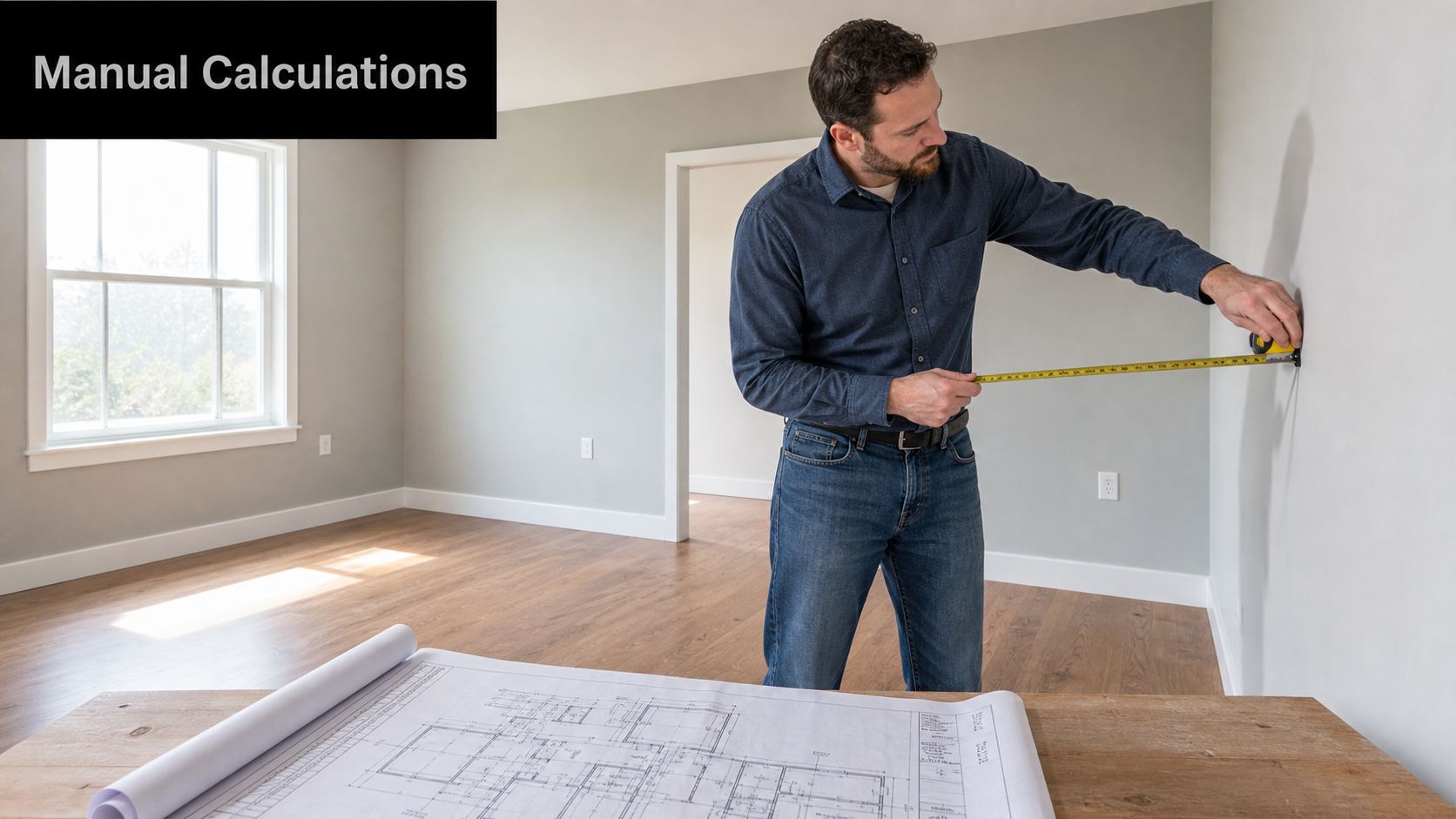
A quick manual check is often enough to spot a bad radiator choice before you buy. I use it as a reality check, especially when an online BTU chart looks suspiciously low or the product output seems generous for the size of the radiator.
The basic manual method
One traditional UK method starts with room volume in cubic feet, then applies a room-use factor. Lounges and dining rooms usually need a higher factor than bedrooms, while kitchens and circulation spaces often need less. That approach is still useful because it stops you sizing a radiator on floor area alone. Ceiling height changes the requirement. So does how the room is used day to day.
If you want a step-by-step version of that method, this guide to how to calculate BTU for a room manually sets out the usual room factors and the standard adjustment approach.
Use the result as a check, not as gospel.
Older manual formulas can still point you in broadly the right direction, but the output only helps if you compare it with radiator ratings at the right test standard. That is where many homeowners get caught out. Plenty of charts and product pages still show outputs at older Delta T ratings such as ΔT60 or ΔT70. In a typical UK heating system, ΔT50 is the figure that gives you a realistic basis for comparison. If you size from an inflated rating, the radiator can look adequate on paper and still leave the room cold.
BTU to Watts conversion
Radiator outputs are often shown in BTU/hr, while electric heaters and some specification sheets use Watts. The conversion is straightforward:
| Unit | Conversion |
|---|---|
| 1 Watt | 3.412 BTU/hr |
| BTU/hr to Watts | divide by 3.412 |
| Watts to BTU/hr | multiply by 3.412 |
This matters when you are comparing different heat sources or checking whether one manufacturer's data lines up with another's.
For example, a radiator rated at 5,000 BTU/hr works out at roughly 1,466 Watts. A 1,500 Watt electric heater works out at about 5,118 BTU/hr. The numbers are close enough to compare directly once you convert them, but only if the radiator output has been quoted at the correct Delta T. If it has been advertised at ΔT60 or ΔT70, the comparison is already distorted.
A visual walk-through can help if you want to see the process in context:
Why this cross-check is worth doing
Manual maths will not replace a full heat loss calculation for a tricky space, but it does expose obvious mistakes. If a tall designer radiator is being sold as suitable for a large outside wall in an older property, a quick volume check and a BTU-to-Watts conversion usually tell you whether the claim is believable.
That extra five minutes can save a lot of frustration. In practice, the common failure is not a wild calculation error. It is choosing from a chart that uses the wrong Delta T, then buying a radiator that only meets the room's demand under outdated test conditions.
Choosing the Right Radiator Type and Output
Once you know the room's heat requirement, the choice becomes less about “Which radiator looks best?” and more about “Which radiator gives that output in a form the room can use properly?”
Horizontal versus vertical
Style-led buying often causes trouble. A horizontal radiator usually spreads heat across a wider section of wall and works in a very predictable way. A vertical radiator can be an excellent solution where wall width is limited, but you can't assume equal dimensions mean equal performance in the room.
The available evidence on this point is worth taking seriously. Guidance from a UK plumbers' discussion source states that vertical radiator heat loss is 25% higher due to ceiling proximity and airflow stagnation, and a 2025 independent study cited there found that vertical radiators in a standard 3m x 4m room needed 1,200 to 1,500 extra BTUs compared with horizontal equivalents, according to this vertical radiator sizing discussion.
What that means for product choice
If you're choosing between radiator types, use this practical lens:
- Horizontal panel radiators suit most standard rooms and are straightforward to size.
- Vertical radiators save wall space and can look excellent, but their output needs checking much more carefully.
- Column radiators often work well where you want character and strong output in one unit.
- Cast iron styles suit period properties visually, but the buying decision should still come back to rated output and room demand.
- Aluminium designs can be attractive where responsiveness matters, especially in spaces that aren't heated all day.
Check the stated output first, then judge the style. Reversing that order is how people end up with a radiator that photographs well and performs poorly.
Don't size by shape alone
A tall radiator can look substantial and still underperform for the room. A compact double-panel model can look ordinary and outperform a more dramatic designer piece. That's why a proper BTU chart for radiators is only useful when it leads into real product output checking.
The safe approach is simple. Match the room requirement to the actual tested output of the radiator you're considering, and treat vertical models with extra caution rather than assuming the dimensions tell the full story.
Use the Bradleys Radiators BTU Calculator
Manual methods are useful, but a good calculator is faster and usually easier for homeowners because it gathers the room details in one place and applies them consistently. The point isn't just convenience. It's reducing the chance of missing a factor that changes the result.

How to use it properly
The most reliable way to use an online tool is to enter the room details carefully rather than rushing through them. A solid workflow looks like this:
- Measure length, width and height accurately.
- Choose the right room type rather than the nearest convenient option.
- Add insulation and glazing details accurately. Don't assume “average” if the room plainly isn't.
- Check orientation and exposure if the tool asks for them.
- Read the recommended output before filtering products by style.
The dedicated radiator heat output calculator makes this process much more manageable than trying to juggle room notes, conversion maths and retailer listings on separate tabs.
One detail that improves the whole system
Sizing the radiator correctly is one half of comfort. Control is the other half. Once the radiator is in place, a thermostatic radiator valve helps regulate how that room behaves day to day. If you want a clear plain-English explanation of valve types and how they work in practice, Neasden Hardware's TRV guide is a useful read.
Why calculators still need judgement
A calculator gives you a recommendation, not immunity from common sense. If the room is awkward, heavily glazed, unusually tall, or you're choosing a vertical designer radiator, treat the output number as the starting point for product selection rather than the finish line.
That's the right way to use digital tools in heating. Let them handle the arithmetic, but keep hold of the judgement.
Common Mistakes to Avoid When Sizing Radiators
The most expensive radiator mistakes rarely start with installation. They start with a bad assumption during buying.
Trusting any BTU figure without checking Delta T
This is the biggest one. In the UK, Delta T50 is the benchmark that matters for radiator BTU ratings. According to UK heating standards, ΔT50 is the mandatory benchmark for radiator BTU ratings, defined as the heat output when the average water temperature is 70°C and room temperature is 20°C, as explained in this Delta T ratings guide.
The same source states that most guides still cite outdated ΔT60 ratings, which can lead homeowners to overestimate required BTUs by 15 to 20%, that 68% of UK radiator charts fail to explicitly state their Delta T rating, and that steel radiators tested at ΔT50 output about 18% less heat than at ΔT60.
That means a chart can look precise and still point you in the wrong direction if the test basis is outdated or hidden.
Other sizing errors that cause trouble
These are the ones seen repeatedly in homes and refurbishments:
- Replacing like for like. The old radiator size isn't proof it was ever correct.
- Buying on looks first. Designer radiators still need to meet the room's output requirement.
- Ignoring awkward room features. Hallways, open landings and rooms with large openings behave differently from simple box rooms.
- Using one generic chart for every space. A lounge, bedroom and kitchen don't demand heat in quite the same way.
A quick buyer's check
Before ordering, ask three plain questions:
| Check | What you need to confirm |
|---|---|
| Output basis | Is the quoted output clearly rated at ΔT50? |
| Room reality | Have you allowed for glazing, exposure and layout? |
| Radiator style | Does the chosen model still meet the target output? |
If the Delta T rating isn't stated clearly, don't assume the BTU figure is directly usable.
That one habit will save a lot of disappointment.
Frequently Asked Questions About Radiator BTUs
Is one large radiator better than two smaller ones with the same total output
Not always. If two smaller radiators let you spread heat more evenly across a room, they can work better than one oversized unit on a single wall. The deciding factors are layout, pipework practicality, furniture position and how the room is used.
Does radiator colour or finish affect heat output
In normal buying decisions, the finish isn't the main thing to worry about. Rated output, radiator type, size and installation position matter more. Choose the finish you want, but only after confirming the product meets the required heat output.
Do TRVs change the BTU I need
No. A TRV controls the room temperature by regulating flow through the radiator. It doesn't reduce the amount of heat the room needs on a cold day. Think of it as a control component, not a substitute for correct sizing.
Should I oversize slightly if I'm between two models
A modest step up is often safer than landing just under the requirement, especially in exposed rooms. The key is “slightly”. You're building in practical headroom, not turning the room into a plant room.
Can I rely on a basic BTU chart alone
Only for an initial shortlist. A basic chart is good for getting into the right range. Final selection should account for room-specific heat loss and the actual tested output of the radiator model you intend to buy.
Why do two radiators with similar dimensions have different outputs
Construction changes output a lot. Panel configuration, convector fins, water content, orientation and overall design all affect performance. That's why visual size is a poor shortcut.
What matters more, radiator size or radiator output
Output. Physical size matters only because it influences the output and the fit in the room. If two radiators occupy similar space but one gives more usable heat at the correct rating standard, that's the better comparator.
If you want help turning room measurements into a radiator choice you can trust, Bradleys Radiators offers a specialist range of designer and traditional models, practical sizing tools, and expert support to help you match the right output to the right style.