
Electric Radiators with Timer: A UK Homeowner’s Guide
You're probably here because the usual heating choices don't quite fit the way you live. Maybe the spare room is cold most of the week but needs to be warm on Friday night. Maybe you work from home and don't want to heat the whole house just to stay comfortable in one room. Or maybe you've looked at your electricity bill and thought, “If I buy an electric radiator with a timer, will it save me money?”
That's the right question.
A lot of advice about electric radiators focuses on features. Touchscreen controls, weekly schedules, app control. Useful, yes, but those aren't the primary issues most UK homeowners care about. The two questions that matter are simpler. Will it cost less to heat the room the way I use it? And can I trust the timer and thermostat to do the job properly?
At Bradleys Radiators, we think of timed electric heating as precision heating. It isn't automatically the cheapest form of heating in every situation. It becomes valuable when you use it in the right room, at the right time, with the right size radiator and the right settings. That's where timer control stops being a gimmick and starts being practical.
Understanding Timed Electric Radiators
An electric radiator with a timer is a room heater that can be programmed to come on and go off at set times. That sounds simple, but it changes how you use heat in the home.
A basic plug-in heater is manual. You switch it on when you feel cold, and switch it off later. A central heating system usually works at house level or at least floor level. Even with zones, many homes still heat more space than they need. A timed electric radiator sits between those two. It gives you single-room control with a built-in schedule.
It functions as a smart alarm clock for warmth. Instead of waking you up, it wakes the room up.
How it differs from standard heating
With a non-programmable heater, you react to the cold. With a timed radiator, you plan ahead. That means your home office can warm up before you start work, or the bathroom can be comfortable before the morning rush.
With central heating, one room often gets heat because another room needs it. With electric radiators with timer controls, each room can follow its own pattern. That's why people often describe them as a simple form of room-by-room zoning.
A few common comparisons help:
| Heating type | How it's controlled | Best suited to |
|---|---|---|
| Basic electric heater | Manual on and off | Short bursts of occasional heat |
| Central heating | Whole-home or broader zones | Regular daily heating across multiple rooms |
| Timed electric radiator | Individual room schedule | Targeted heating based on occupancy |
Why UK homeowners look at them
In UK homes, occupancy patterns are often uneven. One bedroom sits empty most of the day. A garden room is used at weekends. A loft conversion may need heat separately from the rest of the house.
That's where timed heating starts to make sense. You're not buying heat for the whole property. You're buying control over a specific space.
Practical rule: A timer is most useful when the room's routine is different from the rest of the house.
If you're weighing up room-by-room electric heat against a full wet system approach, this guide to electric heating vs gas heating is a helpful comparison. The key point is that timed electric radiators aren't trying to copy a boiler system. They solve a different problem.
The True Benefits of Precision Heating Control
The biggest benefit isn't “cheap heating”. It's controlled heating.
That distinction matters. Electricity is often the more sensitive fuel when every hour of runtime shows up directly on the bill. So the value of a timer isn't that it magically makes electricity cheap. The value is that it helps you avoid paying to heat a room when nobody's using it.
Where timed control makes the most sense
The strongest use cases are the rooms people use in blocks, not all day.
A home office is a good example. If you work there during office hours and close the door afterwards, timed heating lets you warm that room for your working day without sending heat across the whole house. The same logic works in:
- Guest bedrooms that only need occasional comfort
- Bathrooms that benefit from planned warmth before use
- Nurseries or children's rooms where you want a reliable routine
- Conservatories or garden rooms used in shorter sessions
- Rental properties where simple local control can help manage use
Comfort matters as much as cost
People often focus on bills first, but comfort is usually what changes daily life.
A timer means you don't walk into a cold room and wait for it to catch up. You can schedule background warmth before you need the space, then let the radiator reduce output later. That creates a more stable feel than ad hoc switching.
It also reduces the temptation to overuse the boost button. When a room starts warm enough, you're less likely to run the radiator flat out just to recover comfort quickly.
Timed heating works best when it matches your routine. It struggles when every day is treated the same but your real use isn't.
Why this is precision heating
The economic case for electric radiators with timer controls depends more on occupancy, insulation and tariff choice than on the product category alone. That's the useful way to think about them.
If you need to heat one room for a defined period, a timer can help you use electricity more strategically. If you're trying to provide broad, whole-home heat for long stretches, the maths often looks different. In other words, these radiators are strongest when they target the spaces that are used intermittently, not when they replace every other heating method in every room.
That's why precision heating is the right lens. You're not just buying a heater. You're buying the ability to put heat exactly where it belongs.
Essential Features of Modern Timed Radiators
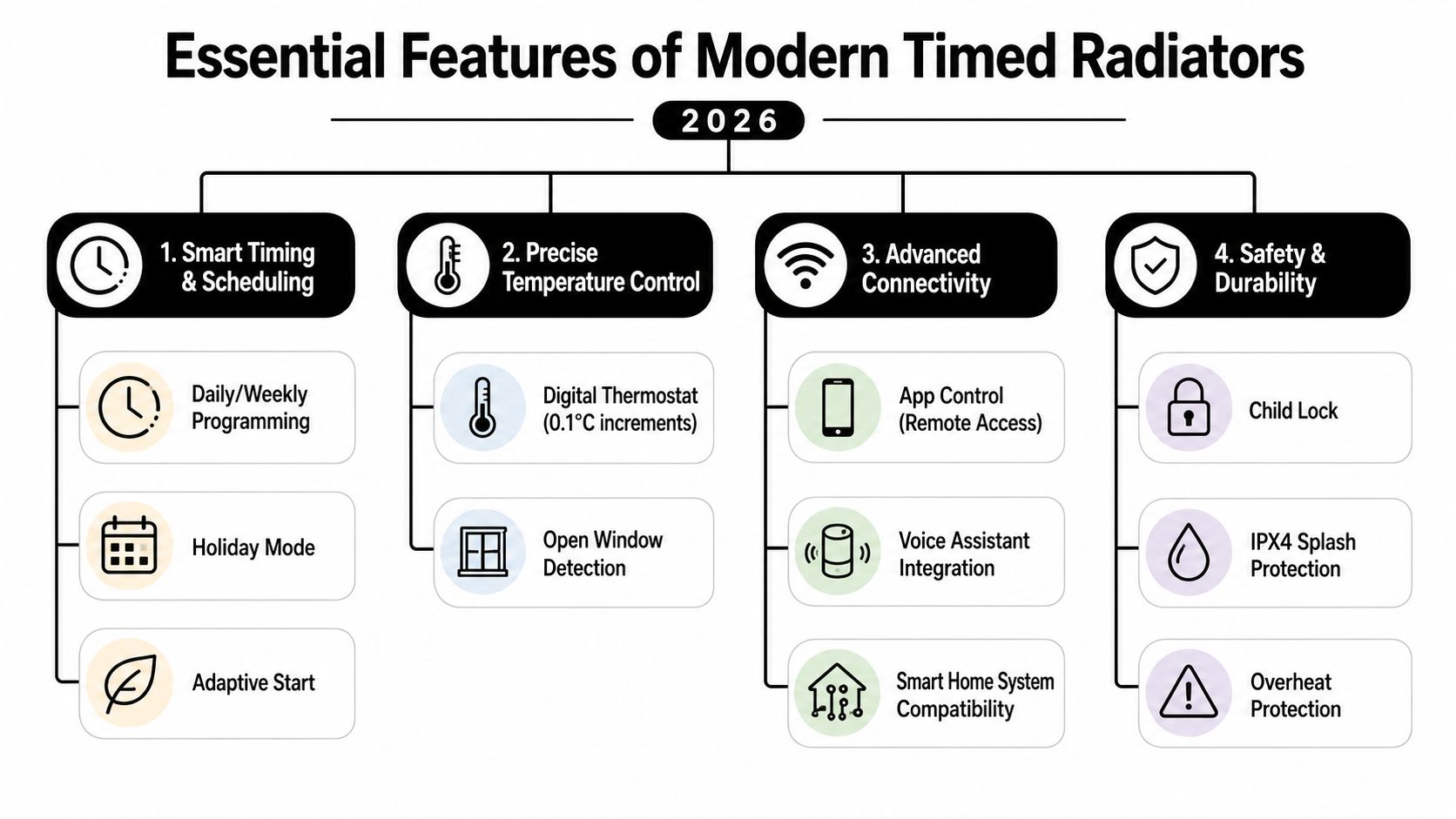
A modern timed radiator should do more than switch on and off. Good controls help the radiator fit the room, the household routine and the way real homes behave through the year.
Timing features that actually matter
The timer itself is the starting point. You want enough flexibility to reflect real life, not just a crude on/off window.
Look for:
- Daily and weekly programming so weekdays can differ from weekends
- Multiple heating periods for rooms used in bursts, such as morning and evening
- Holiday or away mode so the radiator doesn't follow the normal schedule when the house is empty
- Adaptive start on some models, which aims to begin warming ahead of the target time rather than only at the target time
A simple timer can save hassle. A flexible timer can save waste.
Thermostat quality is just as important
Many buyers focus on scheduling and ignore the thermostat. That's a mistake. If the radiator can't sense room conditions properly, even a perfect schedule won't deliver consistent comfort.
A decent digital thermostat should help the radiator maintain a chosen temperature rather than just blast heat whenever the timer says “on”. That's how you avoid rooms swinging from chilly to stuffy.
You'll also see some models with features such as:
| Feature | What it does in practice |
|---|---|
| Digital thermostat | Helps maintain steadier room temperature |
| Open window detection | Can pause or reduce heating if sudden cooling suggests a window has been opened |
| Frost protection | Keeps a room from dropping too low in very cold weather |
Connectivity and safety
App control isn't essential for everyone, but it can be useful if your schedule changes often. If you leave work early or stay away overnight, remote access lets you adjust the room without being there in person.
That said, connectivity should be a bonus, not a substitute for good local controls.
Safety features matter too, especially in family homes and bathrooms. The useful ones tend to be the least glamorous:
- Child lock to stop accidental setting changes
- Overheat protection for reassurance during regular use
- Suitable ingress protection for bathroom locations, where required for the installation zone
- Reliable build quality and mounting hardware so the radiator feels like a fixed heating appliance, not a temporary workaround
If you're used to wet systems, some of these controls may sound familiar. This explanation of thermostatic radiator valves is helpful for understanding the wider idea of room-by-room temperature control, even though electric radiators use different hardware.
Calculating Running Costs and Energy Savings
This is the part people want straight. How much does an electric radiator cost to run?
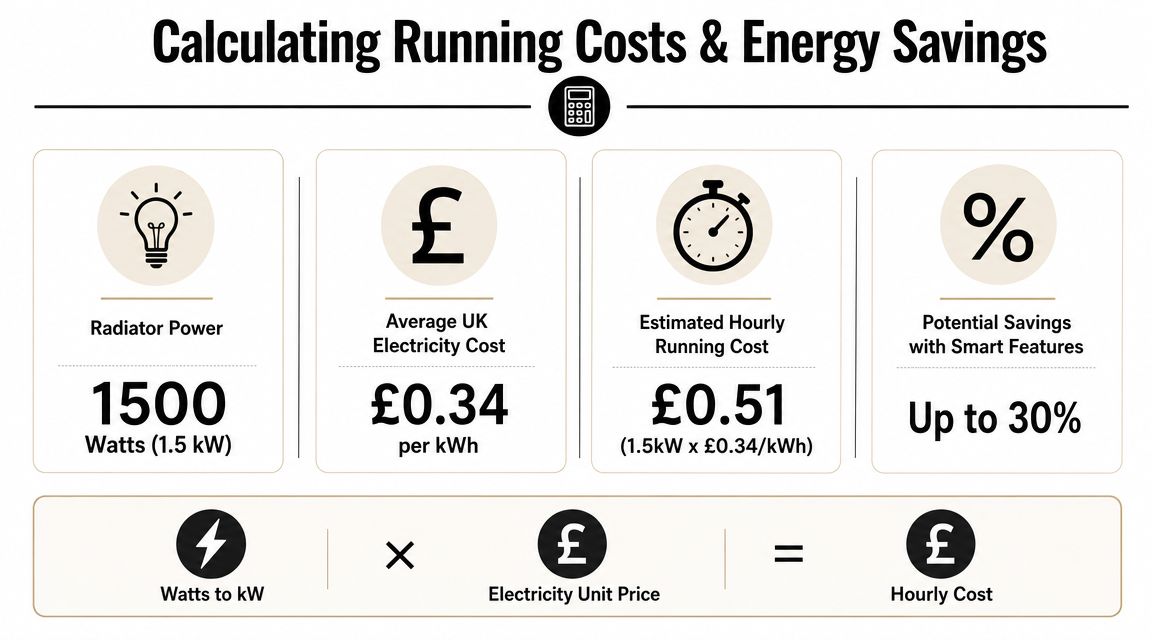
The core calculation is simple. The running cost comes from the radiator's wattage and your electricity tariff. Citizens Advice explains that you convert watts to kilowatts and multiply by the unit rate. It also notes that a 500W heater uses 0.5kW per hour, while a larger 2,000W unit uses 2kW per hour. That's the basic reason timer control matters. Every extra hour is paid for directly.
The formula in plain English
Use this:
Radiator wattage ÷ 1000 = kilowatts
Then:
Kilowatts × your electricity unit rate = running cost per hour
Examples from the same guidance make it easy to picture:
- 500W radiator = 0.5kW per hour
- 2,000W radiator = 2kW per hour
That doesn't tell you the exact bill on its own, because your tariff decides the price you pay per unit. But it does show what drives cost. Bigger radiator, longer runtime, higher tariff. Those are the three levers.
Why timers matter more in the UK
The UK has a long history of off-peak electric heating. Citizens Advice specifically advises that storage heaters with timers should be set to come on during off-peak times, and notes that an hour or two before the end of the off-peak period is often enough to deliver hot water for the day. That advice is aimed at storage heating, but the principle is useful more broadly. If your tariff offers cheaper periods, timed control helps you shift paid-on-rate use into those windows where possible.
That's where electric radiators with timer controls become more than a convenience feature. They become a cost-control tool.
The real savings question
The better question isn't “Are electric radiators cheaper than gas?” It's “Are they cheaper for this room and this pattern of use?”
If you heat a single room only when it's occupied, the timer can stop needless runtime. That's the precision heating argument. You may be paying a higher electricity unit cost than gas in many scenarios, but you're often heating less space, for less time, with tighter control.
That makes timed electric radiators especially relevant for:
- Home offices used on selected days
- Spare bedrooms that don't need daily heat
- Rooms in extensions or lofts with separate usage patterns
- Households on economy-style tariffs where scheduling can line up with cheaper periods
Key takeaway: A timer doesn't change the unit price of electricity. It changes how much of that electricity you buy at the times that suit you best.
If you're comparing product types, this guide to efficient radiators can help you think more clearly about heat delivery, control and suitability. In practice, running cost isn't just about the radiator. It's about whether the room is a good candidate for targeted timed heat.
Choosing the Right Size and Ensuring Safe Installation
A timer only works well when the radiator is properly sized. If the unit is too small, it may start on time but still leave the room underheated when you need it. If it's too large, it can heat aggressively and cycle awkwardly.
That's why sizing comes before clever controls.

A simple UK sizing rule
Screwfix's electric radiator buying guide gives a practical rule of thumb for UK homes:
- 100W per square metre for poorly or moderately insulated rooms
- 60W per square metre for well-insulated rooms
- 125W per square metre for bathrooms
It also advises that for rooms above 30 m², it's often better to use two radiators so the heat is spread more evenly across the space.
That last point is often missed. Heat distribution matters. One oversized radiator on a single wall doesn't always produce the same comfort as two well-placed units.
Why sizing affects timer performance
A timer isn't magic. It can only start the radiator at the right moment. It can't compensate for a heat output mismatch.
If the radiator is undersized, the room may still be climbing towards comfort when you're already using it. If it's oversized, the room may warm too sharply and trigger more stop-start behaviour. Neither gives the smooth, planned comfort most homeowners want.
Correct sizing gives the timer a fair chance to work properly.
For a rough estimate, room area is useful. For a better answer, a calculator that accounts for insulation and layout is the smarter route. Bradleys Radiators' heat output calculator is one example of a tool that helps you move beyond guesswork.
Installation and safety basics
Some smaller electric radiators are straightforward for a competent homeowner to position and use, especially if they're designed as simple plug-in units. Fixed wall-mounted models, larger outputs and bathroom installations need more care.
Keep these points in mind:
- Bathroom use needs the right product rating and correct placement for the room zone
- Hardwired models may require a qualified electrician
- Wall strength and fixing points matter, especially for heavier radiators
- Cable routing and isolation should be neat, safe and compliant
If the radiator is part of a renovation or a finished design scheme, professional fitting usually makes sense. It protects the finish and makes sure the controls are installed where they'll be practical to use.
Programming Tips for Maximum Efficiency
A lot of people assume timed heating is a set-and-forget job. Program it once, walk away, and the savings look after themselves.
In real homes, it's rarely that tidy.
The schedule can be perfectly sensible and still underperform because the thermostat is reading the room badly. That's especially common in older properties, draughty spaces and awkward layouts.
Check the thermostat before blaming the timer
A useful heating advice article notes that users should compare the radiator's displayed temperature with a separate room thermometer, then apply an offset if the radiator over- or under-reads, where that option is available. It also points out that this kind of calibration helps prevent short cycling or overheating in older or draughtier UK homes, and that boost should be used only briefly while the programmed schedule does the main work. You can read that guidance in this programming advice for electric radiators.
That's a more important check than many buyers realise.
If the built-in sensor sits where warm air pools, or near a draught, the radiator may think the room is hotter or colder than it really is. Then the timer appears to be “wrong” when the actual issue is temperature sensing.
A practical setup routine
Try this in order:
- Set your normal occupied hours rather than leaving the radiator available all day.
- Use a separate room thermometer to check whether the displayed temperature is believable.
- Apply an offset if your radiator allows it and the readings are consistently out.
- Keep boost for short top-ups instead of using it as your main heating pattern.
- Review the schedule by season because winter routines often need a longer pre-heat than mild weather.
- Keep the sensor area clear of furniture, towels or clutter that could affect air movement.
Use setback, not panic heating
One of the most useful habits is learning the difference between a comfort temperature and a setback temperature. Comfort temperature is what you want when you're in the room. Setback is the lower level you allow when the room is mostly unused.
That approach often feels better than letting the room go fully cold, then trying to recover heat quickly.
| Setting style | What usually happens |
|---|---|
| Let room go cold, then boost hard | Faster discomfort, more abrupt heating |
| Use a gentle setback between occupied periods | Smoother comfort, less reactive use |
Small schedule changes often beat bigger temperature changes.
If a room never feels right, don't assume the timer is poor quality. Check the sensor reading, the radiator size, and the room's draughts first. Those are the details that usually decide whether timed heating feels clever or frustrating.
How Bradleys Radiators Ensures the Perfect Fit
Choosing electric radiators with timer controls comes down to a handful of decisions. The radiator needs to suit the room, the controls need to match the way you live, and the output needs to be right for the space. If any one of those is off, the result can feel disappointing even if the product itself is sound.
That's why it helps to choose in a more structured way.
Start with the room. Is it used daily, occasionally, or in short bursts? Then look at the finish and form. A vertical designer radiator may suit a narrow wall, while a horizontal model may work better under a window. After that, check the output and installation requirements.
This guide on how to choose a radiator is a sensible place to compare style, room type and heat needs without reducing the choice to appearance alone.
For homeowners who want a cleaner buying process, Bradleys Radiators offers a combination that fits this kind of project well: a broad choice of designer heating styles, an online sizing calculator, and a fixed-cost installation service carried out by its own qualified engineers. That's useful when the job involves more than just ordering a box and hoping the controls, output and fitting all line up.
The main thing is to keep the goal clear. Timed electric heating works best when it's treated as precision heating for the right room, not as a blanket answer for every property. Get the size right, programme it properly, and make sure the thermostat is reading accurately. Do that, and a timed electric radiator can feel less like a compromise and more like a very deliberate upgrade.
If you're ready to choose a radiator that looks right, heats properly and fits the way your home is used, explore Bradleys Radiators. You'll find designer electric options, practical sizing tools and installation support to help you get from first shortlist to finished room with far less guesswork.