
Radiator Vertical: The Ultimate UK Buyer’s Guide
You’re probably here because a standard radiator is getting in the way.
Maybe it sits under the only wall where a sofa really fits. Maybe it blocks kitchen planning. Maybe you’re redoing a bathroom and every inch matters. In a lot of UK homes, especially terraces, flats, extensions, and older properties with awkward layouts, heating isn’t just about warmth. It’s about where the radiator can go without making the room harder to live in.
That’s where a radiator vertical design starts to make sense. It turns a heating appliance from a wide obstacle into a tall, narrow feature that can fit between furniture, beside doors, or on wall sections that a horizontal model would waste.
Introducing the Radiator Vertical Revolution
The big change isn’t just visual. It’s practical.
A traditional radiator spreads across the wall like a long bench. That can work perfectly well in some rooms, but in many UK homes it creates a chain reaction. You move the sofa to avoid the heat. Then the TV unit has to shift. Then curtains hang too close. Then the room feels cramped before you’ve even finished decorating.
A radiator vertical model solves a different problem from a standard one. It gives you heat from a narrower footprint, which can free up more usable wall space and more flexibility with furniture placement. That’s why homeowners now look at them not as unusual designer pieces, but as sensible upgrades when a room layout isn’t working.
That interest has grown sharply. Google Trends data reported by Elegant Radiators on vertical radiator search growth shows searches for “vertical radiator where to buy” increased by 105% over a recent six-month period. That tells you something important. More UK homeowners are actively shopping for this format, not just browsing ideas.
Why that matters: a product doesn’t see this kind of search growth unless people see a real use for it in everyday homes.
The question isn’t just “do vertical radiators look nice?” The better question is “will this shape work better in my room, with my wall space, and with my existing pipework?”
That’s the useful way to approach the decision.
What Makes a Radiator Vertical Besides Height
A vertical radiator isn’t just a horizontal one turned upright in spirit. It changes how you use the room.
Comparing them to buildings: A horizontal radiator is a bungalow. It spreads out and takes up more ground. A vertical radiator is a tower block. It goes upward to do more with a smaller footprint. The total job is still heating the room, but the shape changes how efficiently it uses the available space.

It saves space where you actually need it
This is the first reason for many to switch.
A wide radiator can claim the exact stretch of wall you want for a sideboard, breakfast table, armchair, or storage unit. A vertical model often fits on the wall section that would otherwise be dead space, such as between openings, beside a door, or on a narrow return wall.
That doesn’t mean every room should have one. It means verticals are especially useful when width is the problem and height is available.
A few common examples:
- In kitchens, they can fit between cabinets and doors where a horizontal model wouldn’t.
- In hallways, they work on short wall runs that still need proper heating.
- In living rooms, they can free the main wall for furniture instead of forcing the whole layout around the radiator.
- In bathrooms, they warm the room without occupying the same width as a basin unit or bath edge.
It acts as part of the room design
A radiator doesn’t have to be something you hide.
Vertical models often look more deliberate because their shape reads more like an interior feature than a utility box. That matters in modern rooms, but it can also work well in mixed styles where you want heating to feel considered rather than tucked away.
If you’re comparing formats, Bradleys’ guide on how to choose a radiator is useful for narrowing down style, size, and room suitability before you focus on finish and valves.
A good vertical radiator should look intentional even when the heating is off.
It changes heat flow in practical ways
People often get stuck here. They assume “vertical” means “less effective”. That isn’t the right way to think about it.
The better way is to ask whether the radiator is correctly sized and whether heat can move freely into the room. Warm air rises, so all radiators rely on airflow. A vertical design creates a strong upward path and can work very well in real rooms, especially when it isn’t boxed in by furniture.
Here’s the key practical point. A radiator on paper might have suitable output, but if a sofa, bed, cabinet, or heavy curtain blocks it, the room won’t feel as comfortable as expected. Vertical radiators often dodge that problem because their height keeps more of the heat path clear.
Three takeaways worth remembering
| Benefit | What it means in daily life |
|---|---|
| Smaller wall footprint | More freedom with furniture and storage |
| Stronger visual presence | The radiator can complement the décor instead of disappearing badly |
| Better chance of staying unblocked | Heat has a clearer route into the room |
That’s why a radiator vertical choice isn’t only about style. It’s a planning decision.
Exploring Vertical Radiator Types and Finishes
Once you know a vertical radiator suits the room, the next step is choosing the right build. At this stage, people often mix up material, construction, and style. They sound similar, but they answer different questions.
- Material tells you what the radiator is made from.
- Construction tells you how the radiator is built to deliver heat.
- Style and finish tell you how it will look in the room.

Material choices for UK homes
Each material has its own feel in use.
Steel
Steel is the default choice for many modern vertical radiators. It suits a wide range of interiors, works well in panel designs, and gives a tidy, architectural look.
For many households, steel is the practical middle ground. It offers strong choice in size and finish, and it suits both understated and bolder designs.
Aluminium
Aluminium appeals to homeowners who want a lighter radiator with quick responsiveness. It can be a handy option where wall loading or handling is part of the discussion, and it often pairs well with contemporary interiors.
It tends to suit people who want a sharp, clean look and a radiator that feels modern in both appearance and construction.
Cast iron
Cast iron vertical radiators bring a very different character. They look more traditional, more decorative, and more rooted in period styling. In the right room, they look superb.
They’re often chosen for older homes, heritage-inspired renovations, or spaces where a plain flat panel would feel too clinical.
Designer’s view: if the room already has period cues such as original skirting, fireplaces, or cornicing, a column or cast-iron-inspired radiator usually feels more at home than an ultra-flat slab design.
Construction matters more than many buyers realise
Two radiators can look similar online and perform differently because of how they’re built.
A useful example is the Type 20 vertical panel format. According to this overview of Type 20 vertical panel construction, these radiators use double panels with double convector fins, which improve heat transfer through greater surface area and support stronger convective heat distribution than single-panel alternatives.
That sounds technical, but the everyday meaning is simple. More effective internal design can help the radiator move heat into the room more efficiently.
Popular vertical radiator styles
Here’s where function meets appearance.
Flat panel vertical radiators
These are the clean-lined models many people picture first. They suit contemporary homes, renovated extensions, and minimal interiors. If you want the radiator to look crisp and organised, a flat panel is usually the starting point.
They also tend to be a straightforward choice in kitchens, hallways, and home offices where visual clutter needs to stay low.
Vertical column radiators
Column designs soften the look. They feel more classic and can bridge old and new beautifully. In a Victorian terrace, for example, a vertical column radiator can look like a natural continuation of the house rather than a modern interruption.
They also work well when you want a stronger decorative statement.
Vertical towel radiators
Bathrooms often need a radiator to do two jobs. Heat the room, and hold towels sensibly. That’s where vertical towel radiators come in. They’re practical, visually lighter than many standard bathroom radiators, and well suited to narrow walls.
Finishes and how they change the feel of the room
Finish is not a minor detail. It can decide whether the radiator blends in or stands out.
| Finish | Best for |
|---|---|
| White or neutral | Rooms where you want the radiator to disappear into the wall |
| Anthracite or black | Strong contrast, modern schemes, industrial touches |
| Chrome or metallic | Bathrooms and contemporary spaces that benefit from reflection and shine |
White remains the easiest option if you want a safe, versatile look. Anthracite and black create a stronger feature and often work well with darker frames, hardware, or statement flooring. Chrome tends to suit bathrooms because it feels clean and bright.
How to choose without overthinking it
If you’re narrowing the shortlist, ask these four questions:
Does the room lean modern or traditional?
Flat panels usually suit modern rooms. Columns suit a wider range, especially older homes.Do you want the radiator to blend or stand out?
White blends. Anthracite and black announce themselves.Is wall width or wall strength the bigger issue?
Narrow spaces point you toward vertical. Structural details may influence material and bracket choice.Do you need one job or two?
In bathrooms, towel function can matter as much as heat.
Most confusion disappears once you separate those decisions. First pick the type of look. Then the material. Then the construction level that matches the room’s heating needs.
Sizing Your Radiator for Perfect Heat Output
A radiator can be beautiful and still disappoint if it’s the wrong size.
This is the part buyers often rush because it’s less exciting than colours and finishes. But sizing is what decides whether the room feels comfortable on a cold evening or never quite gets there. With a radiator vertical model, sizing matters just as much as it does with any horizontal one.
BTU in simple language
BTU means British Thermal Unit. In everyday terms, it’s a way of expressing how much heat output a room needs and how much a radiator can provide.
You don’t need to become a heating engineer to use the number sensibly. You just need to treat it as a matching exercise.
- A room that needs more heat requires a radiator with higher output.
- A room that needs less heat can use a lower-output model.
If the radiator is undersized, the room may struggle to warm up properly. If it’s oversized, you can end up paying for output you didn’t need and squeezing a larger unit into the room for no benefit.
Why the t50 standard matters
When you compare radiators, you need a consistent benchmark. In the UK, that benchmark is t50.
According to Stelrad’s explanation of the t50 radiator output standard, t50 uses 75/65/20°C for flow, return, and room temperature. That standard gives UK homeowners and installers a common basis for comparing heat output under realistic domestic central heating conditions.
That matters because not all output figures are equally useful unless they’re measured on the same basis.
Practical rule: compare radiators using the same output standard, or the numbers can mislead you.
What goes into a proper calculation
A good BTU calculation isn’t guesswork. It usually takes account of the room itself and how easily heat escapes.
Here are the main inputs and why they matter:
Room dimensions
A bigger room contains more air to heat.Ceiling height
Taller rooms increase the volume that needs warming.Window details
Glass affects heat loss, especially in older properties.Insulation level
A well-insulated room holds warmth better than a draughty one.Room use and position
A north-facing room or exposed extension may feel very different from an internal room of the same size.
If you want to run those figures properly, Bradleys’ BTU calculator guide explains how the sizing process works and why each input matters.
A simple way to think about sizing decisions
Use this quick checklist before you buy:
| Question | Why it matters |
|---|---|
| How large is the room? | This sets the base heat requirement |
| How much heat escapes? | Windows and insulation can raise the requirement |
| How much wall space do you have? | This shapes whether output needs to go upward rather than across |
| What furniture will sit nearby? | Practical placement affects how heat feels in use |
Where people get caught out
The most common mistake is choosing by appearance first and output second.
A slim radiator vertical design might look perfect on the wall, but if it doesn’t meet the room’s heat requirement, you’ll notice the compromise every winter. The opposite problem also happens. People buy a larger model than necessary because they assume bigger must be better, then realise it dominates the wall.
The right radiator is the one that suits the room on paper and in real life.
Installation Placement and Plumbing Considerations
A vertical radiator can solve a layout problem, but only if it’s installed in the right place and connected sensibly.
In UK homes, theoretical considerations face practical realities. Pipework may already be in place for a horizontal radiator. The wall you want to use may be solid masonry, stud, or old plaster. The nicest-looking location may not be the easiest one to pipe. Getting these details right makes the difference between a clean upgrade and a frustrating one.
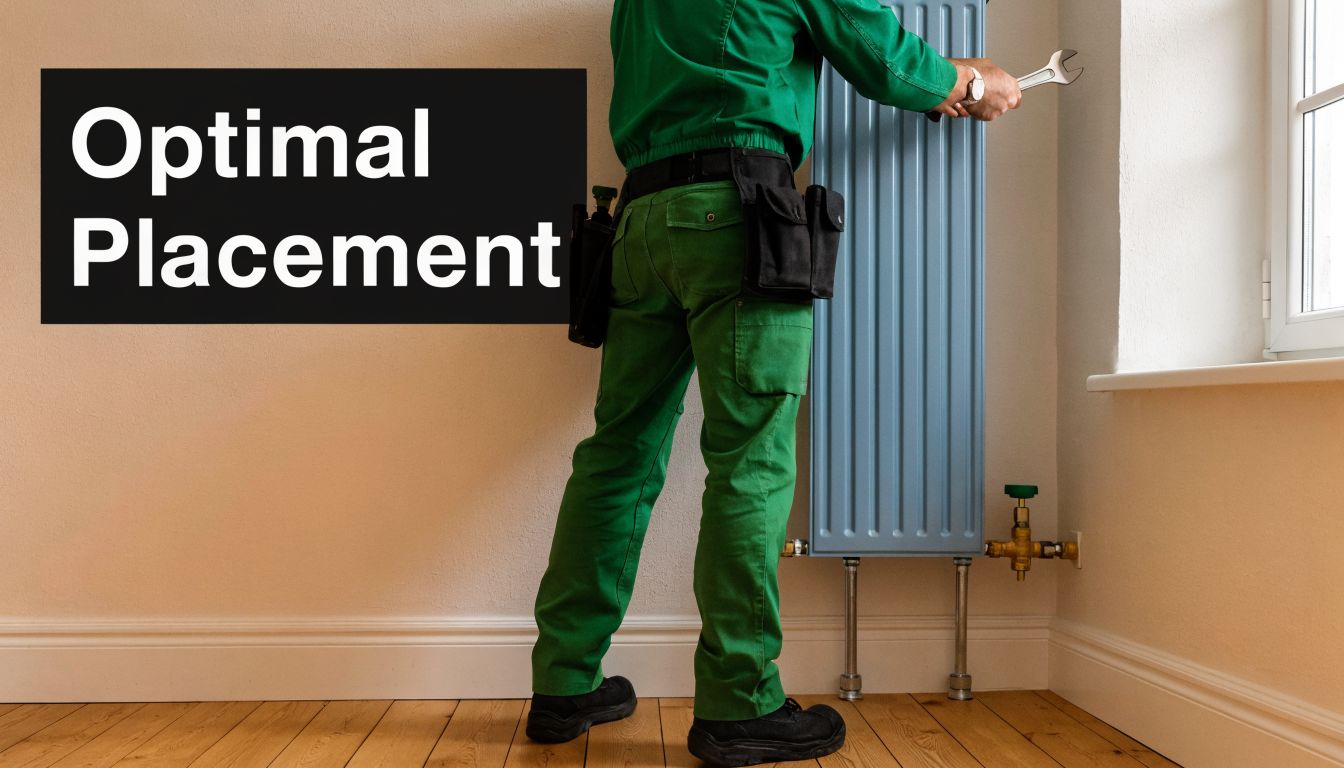
Placement affects efficiency, not just appearance
A radiator works best when air can circulate around it.
Research discussed by Best Electric Radiators on radiator positioning states that correct positioning can reduce energy bills by up to 10%, especially where the radiator stays clear of obstruction. That’s one of the strongest practical arguments for vertical radiators in furnished homes. They’re often less likely to disappear behind sofas, beds, or long curtains.
If you’re choosing a position, start with these checks:
- Leave the heat path open so furniture doesn’t trap warmth at low level.
- Avoid cramming it into a dead pocket where airflow is poor.
- Think about how the room is used, not just how the wall looks when empty.
Existing pipework is often the real challenge
A lot of homeowners assume a vertical radiator is a straight swap. Sometimes it is. Often it isn’t.
If your old radiator was horizontal, the pipe centres and valve positions may not line up with a new vertical model. In many UK terraces and older homes, pipes run visibly along skirting lines or come up through floorboards at positions chosen for a wide radiator. A tall, narrow replacement changes that geometry.
That can mean:
- adjusting pipe routes
- changing valve orientation
- bringing pipe tails closer together
- deciding whether to channel pipes into the wall or keep them surface-mounted
A common frustration is that online advice often stops at “you can fit one”. It rarely gets into the awkward details of converting existing horizontal pipe routes to suit a vertical unit.
If your current radiator works but sits in the wrong place, the plumbing route matters almost as much as the new radiator itself.
Check the wall before you choose the model
Vertical radiators place weight differently from low, wide radiators. The load is concentrated over a taller section of wall, so the fixing method matters.
Before ordering, think about:
Wall type
Solid brick and block walls behave differently from plasterboard stud walls.Bracket quality
The wall brackets and fixing points need to match the radiator and wall construction. If you’re comparing options, radiator wall brackets at Bradleys show the sort of fittings that support secure mounting.Clearances
You still need enough room around the radiator for airflow, access to valves, and decorating.
What installers usually look at first
A competent installer typically checks the practical chain in this order:
- Can the chosen wall safely take the radiator?
- Can the pipework reach cleanly without looking improvised?
- Will the valves sit in a usable position?
- Will furniture block the heat once the room is back in place?
That’s why installation planning is part of choosing the radiator, not something to leave until after delivery.
Styling Vertical Radiators Room by Room
The easiest way to judge a vertical radiator is to place it mentally in a real room. Not a showroom wall. Your room, with your furniture, your storage, and your daily routine.

Kitchen layouts
Kitchens often benefit from vertical radiators because cabinetry, appliances, and doors eat up horizontal wall space quickly. A slim panel model on a spare upright section can keep the room heated without fighting the layout.
In kitchens, surface finish matters too. A clean-lined panel in white, black, or anthracite usually feels easier to integrate than an overly decorative design. The room already has enough visual activity from units, handles, taps, and splashbacks.
Keep a kitchen radiator on a wall that won’t end up hidden by stools, bins, or a utility trolley.
Living room focal points
Living rooms give you more freedom. A vertical column radiator in a bold finish can work almost like a furniture piece. It can anchor a wall beside a window, frame a chimney breast, or give character to an otherwise blank section.
This is often where homeowners stop thinking of the radiator as something to disguise. In a well-planned room, it can echo black-framed glazing, dark shelving, or painted joinery.
One thing to keep in mind is pipework. Existing advice across the market still leaves a gap here, especially for homeowners dealing with awkward old routes and conversions from horizontal setups in period homes. That’s a very real issue in UK terraces where visible or fixed pipe paths may limit where the new radiator can go.
A short visual can help when you’re thinking about proportions and placement.
Bathroom comfort without clutter
Bathrooms are one of the clearest natural fits for a radiator vertical design. Wall space is tight, towel storage matters, and the room benefits from fittings that work hard without feeling bulky.
A chrome towel radiator suits bathrooms that need brightness and reflection. A darker finish can add contrast in more contemporary schemes. If you’re planning this room specifically, bathroom radiator ideas from Bradleys can help you compare practical and visual approaches.
Hallways and small transition spaces
Hallways rarely get much wall freedom. There are doors, frames, consoles, and narrow walkways to think about. A vertical radiator can slip into a section that would never take a horizontal one, while still keeping the entrance warm and usable.
That’s one reason vertical models feel so natural in homes with awkward circulation spaces.
In narrow rooms, the best radiator is often the one that disappears into the plan rather than interrupts it.
Why Choose Bradleys for Your Vertical Radiator
By the time you’ve narrowed down style, output, placement, and pipework, the decision usually becomes simpler. You’re looking for a radiator that fits the room properly and a buying process that doesn’t create more uncertainty.
That’s where a specialist retailer helps. You need clear product information, sensible size options, finishes that suit the interior, and accessories that match the installation rather than forcing compromises later. It also helps to have room-sizing support, because output is just as important as appearance.
Bradleys Radiators offers a UK-focused range that covers designer vertical models, column styles, bathroom options, valves, and accessories. The site also includes a built-in BTU calculator for room sizing, plus practical filters for finish, dimensions, room type, and budget. For homeowners who don’t want to coordinate separate trades, there’s also a fixed-cost installation service handled by an in-house team of qualified engineers.
The wider buying details matter too. Free standard delivery, selected fast dispatch, and manufacturer warranties of 5 to 10 years are part of the overall offer described on the site. That gives buyers a clearer path from shortlist to fitted radiator without piecing everything together from multiple suppliers.
A vertical radiator is often the right answer when a room needs both heat and a better layout. The trick is matching the product to the home, not just picking a finish you like online.
Frequently Asked Questions
Can a vertical radiator heat a large room
Yes, it can, if it’s sized correctly for the room. The shape doesn’t decide the result on its own. The important thing is matching the radiator’s output to the room’s heat requirement.
Are vertical radiators more expensive to run
Not automatically. Running cost comes back to choosing the correct heat output for the room and installing the radiator where airflow isn’t blocked. A poorly matched radiator of any shape can be wasteful.
Do I need special valves for a vertical radiator
Sometimes. It depends on where the pipework enters and how the radiator is designed to connect. Angled, straight, or corner valves may each be appropriate depending on the setup.
Are vertical radiators suitable for old UK houses
Often, yes. They can work especially well in period homes with awkward wall layouts. The main thing to watch is the existing pipework route, because older plumbing positions don’t always line up neatly with a new vertical model.
Should I fit a thermostatic valve
In most homes, a thermostatic valve is worth considering because it helps control room temperature more precisely. If you want the basics explained clearly, this guide to thermostatic radiator valves is a useful starting point.
If you’re ready to choose a vertical radiator that suits your room layout, finish preference, and heating needs, have a look at Bradleys Radiators. You’ll find designer vertical options, practical room-sizing tools, and installation support for a more straightforward upgrade.