
Radiator Installation Preston: Your 2026 Guide
You’re usually not looking up radiator installation in Preston for fun. It’s normally because something in the house has started annoying you every day. One room never gets properly warm. The old radiator looks tired against a freshly decorated wall. You’ve found a lovely vertical model online, then immediately thought, “Can this go where the old one is, and what’s the whole job going to involve?”
That’s a sensible question.
A radiator swap sounds simple until you start bumping into the details. Size, heat output, brackets, valves, pipe positions, wall strength, floor coverings, bleeding, balancing, warranties. None of it is impossible to understand, but it helps when someone explains it in plain English.
Think of this as the owner’s manual for the whole journey. If you’re planning radiator installation preston work in your home, this will help you choose the right radiator, understand what happens on the day, make sense of costs, and know what good workmanship entails.
Choosing Your Perfect Radiator for a Preston Home
The first mistake people make is choosing with their eyes only.
I get it. You see a slim anthracite vertical radiator, or a chunky multi-column model, and you can already picture it on the wall. But a radiator has two jobs. It has to look right and it has to heat the room properly. If either part is wrong, you’ll notice it every winter.

Start with heating power
You’ll often see BTU mentioned when shopping for radiators. That means the heating output a room needs. The easiest way to think about it is like choosing an engine size for a car. Too small, and it struggles. Too big, and you can end up paying for something you didn’t need.
A small downstairs loo in a newer build needs far less output than a front lounge in an older Preston terrace with higher ceilings and colder external walls. The room tells you what radiator it needs.
The basics that affect sizing are:
- Room dimensions. A bigger room needs more heat.
- Ceiling height. Older homes often have taller ceilings, so there’s more air to warm up.
- Window type. Single glazing loses heat faster than double glazing.
- Wall construction. Solid walls behave differently from insulated cavity walls.
- How the room is used. A bedroom, kitchen and bathroom all feel comfortable at different temperatures.
If you want a practical starting point, use a proper radiator choosing guide and a BTU calculator rather than guessing from the size of your old radiator.
Practical rule: Never assume the old radiator was the right size. Plenty of homes have lived with undersized radiators for years.
Preston homes aren’t all the same
This situation frequently catches homeowners by surprise. “It’s just a standard bedroom” sounds straightforward, but the house itself changes the answer.
A Victorian terrace near the centre might have draughtier floors, higher ceilings and older walls. A 1930s semi may have been extended, which means one part of the room behaves differently from another. A modern estate home is often easier to size because insulation is more predictable.
Here’s a simple way to think about common room situations:
| Home type | Common radiator sizing challenge | What to watch for |
|---|---|---|
| Victorian terrace | Heat loss through walls and height of room | Don’t undersize for appearance alone |
| 1930s semi | Mixed insulation from upgrades over time | Check windows and external walls |
| Modern new-build | Smaller heat demand in many rooms | Avoid buying larger than needed |
| Open-plan extension | Big glazed areas and awkward wall space | Consider vertical or feature radiators |
Material matters more than people expect
Once the sizing is right, then you can look at the radiator build itself.
Steel radiators are the usual all-rounder. They suit most homes, come in loads of finishes, and work well in both modern panel styles and column designs.
Aluminium radiators heat up quickly and are handy where you want a responsive feel. If you like rooms warming up fast after the heating comes on, they’re worth a look.
Cast iron radiators suit period homes beautifully. They’re heavier, more traditional in character, and often chosen for looks as much as performance. They can be a lovely fit in older Preston homes with original features, but they need proper support and planning.
A radiator isn’t just a metal box on the wall. Its material affects how quickly it responds, how heavy it is, and what sort of wall fixing it needs.
Shape and style should solve a problem
Style isn’t only decoration. In a good installation, the radiator shape also solves a layout issue.
A vertical radiator can free up wall space where a sofa, sideboard or kitchen units would clash with a long horizontal model. A horizontal column radiator can look softer and more in keeping in a period room. A flat panel radiator often works well where you want a cleaner, minimal finish.
Think about the room from a practical angle:
- Behind a door swing. A deep column radiator may not be ideal.
- Under a window. A lower horizontal radiator often makes sense.
- Narrow wall between furniture. Vertical models can save the layout.
- Feature wall. The radiator finish becomes part of the room design.
Don’t forget the valves and finish
Valves are small, but they change the final look more than people realise.
A white radiator with chrome valves gives a different feel from the same radiator with anthracite or black valves. Straight valves suit some pipe layouts, angled valves suit others. If you’re trying to create a tidy fitted look, the valve choice matters.
This is also the point where homeowners usually ask whether a dark radiator gives off less heat than a white one, or whether a designer radiator is “just for looks”. The honest answer is that design models can work very well, but only if the output matches the room. A beautiful radiator that’s too weak for the space is still the wrong radiator.
A simple selection method
If you’re narrowing options down, use this order:
- Measure the room properly
- Work out the heat requirement
- Decide where the radiator can realistically go
- Choose the shape that suits the wall space
- Pick the material and finish
- Match the valves to the pipework and style
Do it in that order and you avoid most expensive mistakes.
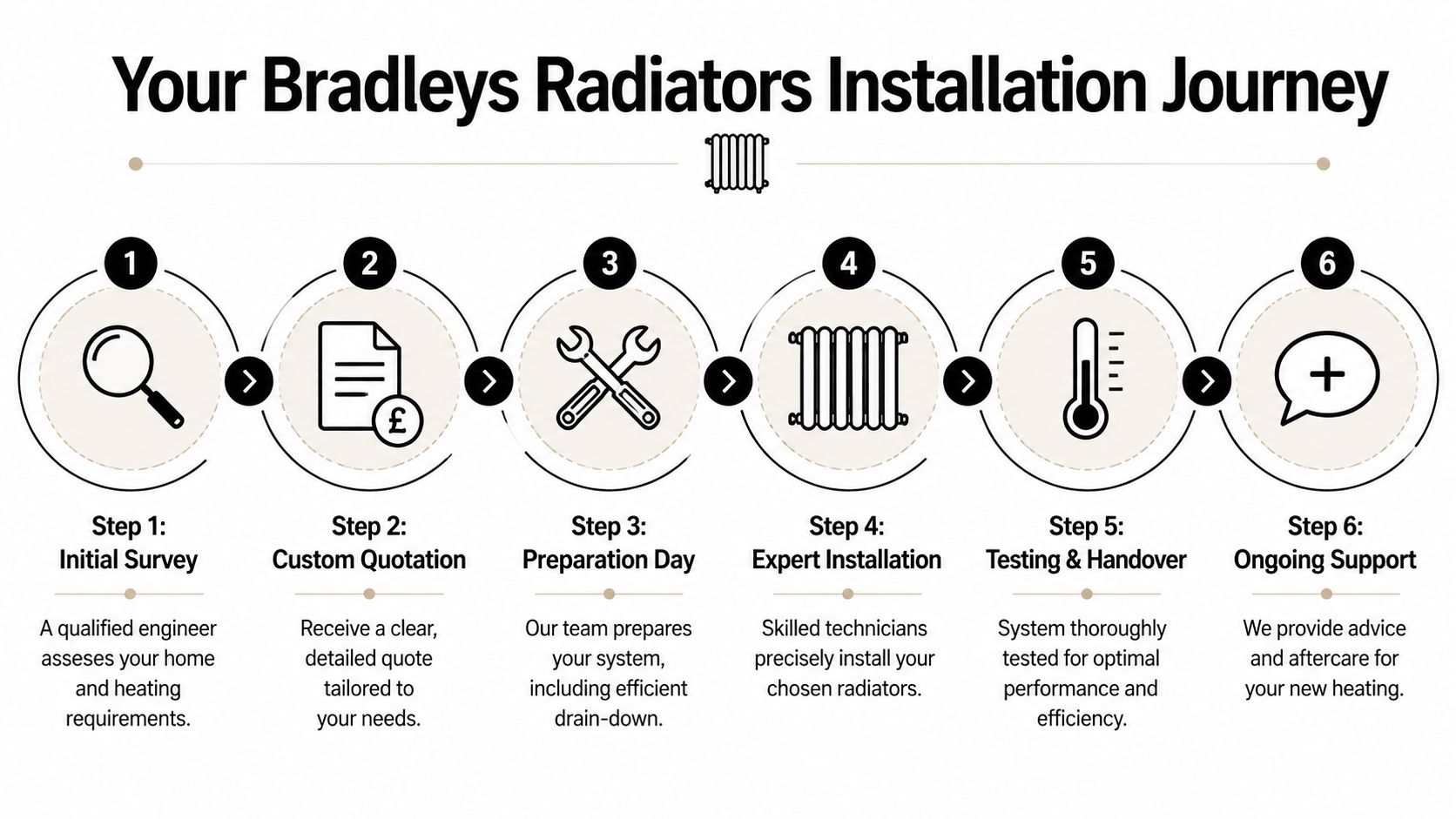
The Bradleys Radiators Installation Process Step by Step
Customers appreciate knowing what occurs on the day. Not the sales version. The genuine version.
The job is usually calm and methodical when it’s planned properly. Floors are protected first, the system is made safe, the old radiator comes off, the new one goes on, then everything is tested before anyone packs away.
Before any tools come out
Good installation starts before the first spanner touches a valve.
The room needs a bit of access. That doesn’t mean stripping it bare, but it helps to clear small furniture, ornaments and anything delicate near the radiator wall. If you’ve got fresh carpets, laminate, or recently painted skirting, that’s exactly why careful prep matters.
A typical visit starts with:
- Protecting the area with dust sheets and floor coverings
- Checking the chosen radiator against the wall space and pipe centres
- Confirming valve type and whether any pipe alterations are needed
- Looking at the wall structure before brackets are fixed
Draining or isolating the radiator
People often assume the whole heating system must always be drained. Sometimes it does. Sometimes the engineer can isolate the section being worked on.
That choice depends on the system layout, the valves already fitted, and whether pipework is being altered. A straightforward like-for-like swap is often simpler than relocating a radiator to a different wall.
Once the water side is under control, the old radiator can be removed cleanly. There’s usually a bit of residual water inside, so careful handling matters. That’s one of those parts of the job that looks easy until dirty heating water lands on a pale carpet.
Removing the old radiator and preparing the wall
At this stage, hidden issues show up.
Old brackets may not line up with the new radiator. The plaster behind the old unit might be weaker than it looked. Pipe tails may sit too high, too low, or slightly off square. None of that means the job has gone wrong. It just means a proper fitting has to be adapted to the house in front of you.
This is also the right point to check brackets carefully. For heavier or taller models, bracket layout isn’t a cosmetic detail. It’s part of making the radiator safe, level and efficient.
Later in the fitting, accurate bracket placement becomes critical. The technical guidance for installations notes that a typical 600x1800mm vertical radiator requires 6-8 brackets spaced 400-500mm apart, with a minimum 4-inch clearance from the floor. If that support and clearance are wrong, sagging can cut thermal efficiency by up to 15-20%, and poor height can reduce output by 10-12%. The same guidance links these requirements to BS EN 442 and says they help preserve 5-10 year warranties in qualifying installations, as outlined in these radiator technical specifications.
If you’re curious about the hardware itself, it helps to understand the different radiator wall bracket options before the day of fitting.
Fixing brackets and mounting the new radiator
This is the part that separates a neat job from a troublesome one.
The radiator has to sit level, at the right height, with brackets secured to a sound fixing point. On solid walls, that usually means proper masonry fixings. On stud walls, the engineer has to think carefully about support, especially with heavy column or cast iron models.
If a radiator isn’t supported properly, you may not notice immediately. Problems often show up later as movement, noise, strain on valves, or a slow drip that starts months down the line.
Once the brackets are fixed, the radiator is mounted and the valves are fitted. New valves are often a sensible choice during replacement, especially if the old ones are tired, stiff, or mismatched to the new radiator style.
Here’s a useful visual overview of the sort of process homeowners often want to see before booking:
Refilling, bleeding and checking performance
After fitting, the system is refilled or reopened, then the radiator is bled to remove trapped air.
That’s the point where leaks are checked at every joint, valve and connection. The engineer also confirms the radiator is heating evenly and that the valves are operating properly. If the system needs balancing because one radiator is heating far faster than another, that should be picked up too.
A tidy finish matters here as much as the plumbing. The radiator should look square to the wall, the valves should be aligned neatly, and packaging and old parts shouldn’t be left for you to sort out.
What a homeowner should notice
By the time the job’s done, you should be able to see a few simple signs of a proper installation:
| What you see | What it usually tells you |
|---|---|
| Radiator sits level | Brackets have been set accurately |
| No marks or water on flooring | The drain-down and handling were controlled |
| Valves feel smooth and aligned | The finishing has been done carefully |
| Heat spreads evenly across the radiator | Air has been bled and flow is working properly |
The best installation day doesn’t feel dramatic. It feels organised.
Radiator Installation Costs in Preston Explained
Cost matters. It’s usually the question people want answered first, even if they ask it second.
The honest answer is that radiator installation preston pricing depends on the type of job, not just the radiator itself. Replacing one standard radiator in the same position is a very different task from moving pipework, fitting a tall designer model, or hanging a heavy unit on a wall that needs extra support.
What changes the quote
A fixed quote is usually built from a handful of practical factors.
Like-for-like swaps are normally the most straightforward. If the new radiator is similar in size and the pipe centres line up well, labour is simpler and cleaner.
Pipework alterations add complexity. If you want the radiator moved to another wall, or the new model has a very different connection point, the job takes longer and needs more making good on the plumbing side.
Radiator type affects fitting time too. A lightweight panel radiator is not the same job as a large column, cast iron, or tall vertical model that needs more careful handling and support.
Example Radiator Installation Costs in Preston 2026
The table below is illustrative rather than a promise of a final price. It’s there to help you see how different job types usually sit relative to one another.
| Installation Scenario | Description | Estimated Cost |
|---|---|---|
| Like-for-like replacement | Old radiator removed, new radiator fitted in same position with minimal pipe adjustment | Quote depends on radiator size, valve choice and access |
| Designer radiator swap | Standard radiator replaced with a vertical or feature model in the same general location | Quote depends on bracket requirements, wall type and connection points |
| Radiator relocation | Existing radiator moved to a different wall or position in the room | Quote depends on extent of pipework changes and floor or wall access |
| Multiple room upgrade | Several radiators replaced during the same visit or project phase | Quote depends on number of units, property layout and system condition |
| Heavy radiator installation | Column, cast iron, or other weighty radiator requiring careful support planning | Quote depends on wall strength, lifting requirements and fixings |
Because there isn’t verified local market pricing data available, the sensible way to budget is by job type rather than by a made-up figure. If anyone gives you a universal “standard radiator fitting cost” without asking about pipework, wall construction or radiator weight, they’re probably oversimplifying.
What should be included
When you compare quotes, don’t only look at the headline number. Check what the installer is including.
A proper radiator replacement quote often covers:
- Engineer time for removal and installation
- Drain-down or isolation work on the system
- Standard fittings and connection work
- Mounting and bracket installation
- Refilling and bleeding the radiator
- Testing for leaks and operation
- Removal of the old radiator and packaging
If one quote looks much cheaper, it may have left out valves, disposal, pipe alterations, or the final testing stage.
Cheap quotes often become expensive jobs when “extra bits” start appearing halfway through the install.
Why size affects cost twice
Radiator size influences the budget in two different ways. First, it changes the product cost. Second, it can change the installation work.
A larger or taller radiator may need different brackets, more secure fixings, or a second pair of hands for lifting and positioning. If you’re still comparing options, it helps to check your heat requirement first with a proper room BTU calculation guide, because buying the wrong size can waste money on both the radiator and the fitting.
A good quote feels clear
You shouldn’t need plumbing experience to understand a quotation.
A good one tells you what radiator is being fitted, whether valves are included, whether pipework alterations are allowed for, and what happens to the old unit. If there are possible extras because the wall or pipework can’t be fully assessed until the old radiator is off, that should be explained plainly up front.
That sort of clarity makes budgeting easier, and it usually tells you a lot about how the installation itself will be handled.
Timelines Warranties and Peace of Mind
Most homeowners don’t mind work being done in the house if they know how long it’s likely to take and what protection they’ve got afterwards.
For radiator replacement, the timing usually comes down to complexity. A simple swap is often much quicker than a move to a new wall, because moving position means changing pipe routes, checking new bracket points and sometimes dealing with awkward floor or wall access.
How long the work usually takes
A straightforward radiator swap can often be completed in 2-4 hours. A more involved installation with pipework changes might take a full day.
That difference matters when you’re planning around work, school runs or access to certain rooms. A bedroom swap may be easy to schedule. A kitchen or main living room installation usually needs a bit more thought because it affects the space you use most.
A sensible installer will also tell you that houses don’t always behave exactly as expected. Old valve tails seize. Walls crumble around old fixings. Pipe centres are not quite where they appeared. None of that is unusual. What matters is that the timing estimate leaves room for the reality of older homes.
Warranty on the radiator and warranty on the fitting
These are not the same thing.
The manufacturer’s warranty covers the radiator product itself, subject to the maker’s terms. For many products sold through specialist suppliers, warranties can run for 5-10 years, as stated in the publisher information provided for the product range.
The installation guarantee is about workmanship. It includes the quality of the fitting, the connections, the bracket mounting and the standard of the job carried out on site. Homeowners should always ask where one protection ends and the other begins.
Here’s the simplest way to view it:
| Protection type | What it covers |
|---|---|
| Manufacturer warranty | The radiator as a product |
| Workmanship guarantee | The standard of the installation |
Why support and substrate matter
Heavy radiators put stress on walls in ways lightweight units don’t.
A plastered wall may look solid, but the real question is what’s behind it and whether it can take the load over time. That’s especially important for column and cast iron radiators. If the support behind the bracket isn’t right, the finish can start to crack, the radiator can shift slightly, and strain can build around valves and connections.
If you want to understand why wall construction matters so much, this guide on proper substrate and support for heavy radiators explains the principle well.
Peace of mind doesn’t come from paperwork alone. It comes from knowing the radiator is the right product, on the right wall, fitted the right way.
What reassurance should feel like
Real reassurance is specific.
You should know roughly when the engineer is arriving, how long the room will be affected, whether the old radiator is being removed, and what happens if there’s a problem after the install. Vague promises are less useful than clear boundaries.
When timing and warranty are explained properly, radiator replacement stops feeling like a gamble and starts feeling like a planned home improvement.
Why Choose a Preston Specialist Like Bradleys Radiators
There’s nothing wrong with using a general plumber for many jobs. But radiator replacement isn’t always a basic swap, especially once you step into designer, vertical, column or heavy models.
That’s where a specialist approach starts to make sense. You’re not only buying labour. You’re buying product knowledge, installation judgment and fewer chances for things to go wrong between supply and fitting.

Specialist knowledge helps before the install
A general installer may be perfectly competent at fitting a common panel radiator. The challenge comes when the homeowner wants a specific finish, unusual size, vertical format, or a traditional column look that also needs to meet the room’s heating demand.
That decision happens before installation day. If the supplier and installer aren’t aligned, you can end up with a radiator that looks right in the brochure but creates awkward pipework, poor placement or support issues on site.
A specialist retailer-installer model can reduce that mismatch. Bradleys Radiators, for example, combines radiator selection tools, product supply and fixed-cost installation through in-house engineers, which is a factual difference in how the service is organised.
One point of responsibility matters
Homeowners often underestimate how helpful this is until something becomes unclear.
If you buy the radiator from one company, the valves from another, and the fitting from someone else, small disputes can start quickly. Is the radiator unsuitable, or was it fitted incorrectly? Were the brackets wrong, or was the wall assessed badly? Who’s sorting the missing part?
With a joined-up service, responsibility is simpler. That doesn’t make every job perfect by magic, but it makes communication cleaner.
Designer radiators need more than basic fitting
A modern vertical radiator, a six-column model, or a cast iron unit can all place different demands on the installer.
Here’s where specialists often add value:
- Product matching. They’re more likely to spot when style and heat output don’t line up.
- Valve compatibility. They understand what suits the radiator and the pipe layout.
- Bracket planning. Heavier or taller models need more care with support.
- Finish awareness. They tend to treat visible details like spacing, level and symmetry as part of the job.
That matters because radiator replacement sits halfway between plumbing and interiors. If either side is ignored, the finished result can feel off.
A local specialist also understands common house types
Preston homes aren’t all built from the same template.
A local specialist is more likely to recognise the quirks of older terraces, semis that have been altered over time, and newer properties where clean lines matter to the final look. That local familiarity doesn’t remove every surprise, but it helps with realistic planning.
The best radiator install is one that looks as if it was always meant to be there.
You’re also less likely to be left chasing faults
If a radiator later seems slow to warm, noisy, or uneven, you want someone who understands both the product and the system context. That’s harder when the seller and fitter are disconnected.
If you’ve ever dealt with a radiator that’s lukewarm at the top, cold in patches or generally disappointing, this guide on a radiator not heating up properly is useful background before you choose who installs the replacement.
In practical terms, choosing a specialist is usually about reducing friction. Fewer crossed wires. Better fit between product and room. Clearer accountability if anything needs adjusting.
Your Radiator Installation Questions Answered
These are the questions people usually ask just before they book.

Do you need to drain the whole heating system for one radiator
Not always.
If the system and valves allow, an engineer can sometimes isolate the section being worked on. In other cases, a fuller drain-down is the cleaner and safer option. It depends on the setup in your home and whether the job involves changing pipework as well as swapping the radiator.
Will the old radiator and packaging be taken away
That should be clarified in the quote, but many homeowners expect this as part of the fitting service.
It’s a fair question to ask directly. Old radiators are awkward, dirty inside, and not something to be left in the garden or garage after the job.
What if you’ve got laminate flooring, carpet or fresh décor
A careful installer should protect the work area and move through the job with as little mess as possible.
There’s always some handling involved when draining and removing a radiator, but that doesn’t mean your room should be left in a state. Dust sheets, careful lifting and clean connection work matter most in decorated rooms.
Can a new radiator go in the exact place as the old one
Sometimes yes, sometimes not neatly.
Even when the wall position stays the same, the new radiator may have different width, height, depth or connection points. That can mean altering brackets, valves or short sections of pipework. This is common, not a problem.
Is it worth replacing valves at the same time
Often, yes.
If the old valves are worn, seized, leaking slightly, or don’t suit the new radiator visually, replacing them during the radiator install is usually tidier than revisiting the job later. It also gives you a cleaner finished look.
Can you install a radiator bought elsewhere
That depends on the installer’s policy.
Some will fit customer-supplied radiators. Others prefer to supply the radiator themselves so they know exactly what’s being installed and what warranty chain applies. If you’ve already bought one, ask before booking so everyone is clear.
A quick phone call before booking can save a lot of confusion on the day. Ask about disposal, valves, wall type, and whether any pipe alterations are likely.
How do you know if the radiator is the right size
Don’t judge by eye.
Use room measurements and a BTU calculation, especially if you’re changing style or shape. A tall narrow radiator may look smaller than the old one while still being suitable, or it may not. The numbers behind the choice matter more than first impressions.
Will the room be out of action all day
For a straightforward swap, not usually.
For a more involved relocation or heavy radiator install, it may be sensible to expect the room to be disrupted for longer. The key is knowing that before the engineer arrives, not discovering it halfway through.
If you’re planning a heating upgrade and want a clear starting point, Bradleys Radiators lets you browse radiator styles, compare finishes, check sizing tools and explore installation options before you commit. That makes it easier to move from “we should probably replace that radiator” to a decision that suits your room, your house and your budget.